
The fastest growing consumer lending product category in the U.S. is unsecured personal loans. According to TransUnion’s Q2 2026 Credit Industry Insights Report, outstanding personal loan balances reached a record $281 billion in Q2, up 9.6% YoY, more than double the next-fastest category and roughly 3.5x the overall market.
These statistics are especially striking to me because of the inherent flexibility of personal loans. Unlike auto loans or mortgages, personal loans don’t have a prescribed purpose. Consumers can and do get them for all kinds of different reasons. And unlike credit cards — another general purpose consumer credit product — personal loans have a much higher risk profile because they are only underwritten once. Personal loan lenders, unlike credit card issuers, don’t have the luxury of approving borrowers for a low initial limit and then increasing it slowly over time as borrowers demonstrate their willingness and ability to repay. It’s a one-shot deal. The consumer asks for a large chunk of money and the lender has to decide whether or not to give it to them.
Given the open-ended nature of this product, it’s not surprising that one of the first questions that lenders ask, when evaluating a consumer for a personal loan, is, “What are you planning to use the money for?”
According to TransUnion, the most common answer is to consolidate and refinance existing debts down to a lower interest rate. This was confirmed to me by the lending executives I spoke with while researching this essay, who told me that at least 80% of personal loan applications list debt consolidation and refinance as the reason for seeking the loan.
If you consider the overall state of U.S. consumers’ balance sheets, this makes sense.
As of the first half of this year, total U.S. consumer household debt stood at a record $18.8 trillion, according to the Federal Reserve Bank of New York. While credit card debt makes up a relatively small component of that — $1.25 trillion — it has increased by a staggering 63% since the COVID pandemic and it carries an average interest rate of 22.15%, which is roughly double the average interest rate paid by U.S. consumers on any other mainstream credit product. That’s a burden that consumers would obviously want to lighten, which is why the demand for debt consolidation via personal loans is at an all-time high.
However, what’s fascinating to me is how ineffective this product is at fulfilling its primary function.
In 2023, TransUnion studied the way in which consumers used personal loans for debt consolidation. They found that among consumers who used personal loans to consolidate credit card debt, credit card balances were only reduced by 57%. Even more troubling, TransUnion found that these reductions only lasted for about 18 months, before consumers’ revolving debt returned to nearly the same levels they were at before.
In other words, for most consumers who take out personal loans for debt consolidation, the benefits are only partial and temporary.
This has been an open secret among credit risk professionals for a long time. When I worked at FICO, we had to adjust the way that the FICO Score (in version 10 of the model) handled personal loans, particularly for debt consolidation. Under older versions of the model, consumers would see a significant increase in their credit scores when their revolving credit utilization decreased, which made sense in an era where credit card debt reduction could only be achieved slowly and methodically through disciplined budgeting and financial management. However, when fintech companies like LendingClub and Prosper revolutionized the personal lending market in the 2010s — by pairing automated underwriting with streamlined digital applications — they made it much easier for consumers to quickly reduce their credit card debt, which, in turn, made that a much less reliable signal of responsible behavior in credit scoring models like FICO.
Now, to be clear, not all consumers who apply for a personal loan with the stated intention of consolidating existing debts actually intend to keep their debt levels low. In fact, I would hazard a guess that a large percentage of credit card revolvers who consolidate their debts do so only so that they can temporarily boost their credit scores and/or refill those cards up with even more debt. This is something that happens frequently. We would be naive to think otherwise and FICO and the credit risk professionals that rely on it would be stupid to not discount this behavior in their scoring models.
That said, this isn’t true for everyone who takes out a personal loan for the purpose of debt consolidation. Some portion of these consumers — perhaps even a majority — are doing so with the intention of permanently altering their financial trajectories for the better.
But something stops them. Something stops that intention from being translated into action.
Today’s essay is about that intention-action gap, what it reveals about the challenge of creating certainty, and the benefit of certainty — to consumers and lenders — once we have it.
Close Doesn’t Count
The first thing that happens after a consumer is approved for a personal loan to consolidate credit card debt is straightforward: The lender disburses the proceeds into the borrower’s checking account or cuts them a check and puts it in the mail.
At that point the lender’s involvement, for all practical purposes, ends.
What happens next is entirely up to the borrower, who now has to go out and manually retire four or five credit card balances across four or five different servicers, each with its own website, its own login, its own payoff quirks, and its own definition of what “paid in full” means on a given day. Some of those accounts might not be payable online at all. Some of them will have accrued interest since the last statement, so the number the borrower thought they owed isn’t the number that actually closes the account.
This is not a hard task, exactly. But it is a tedious one, spread across multiple apps, websites, and call centers, at a moment when the borrower has just experienced the psychological relief of a large sum of money arriving in their account.
And crucially, the money is fungible while it sits there. Every day the proceeds remain in a checking account is a day they can be partially spent on something else, entirely without malice or bad intent. A car repair comes up. A tuition bill. The borrower tells themselves they’ll pay the last card down next month.
Some of it gets done. Some of it gets done partially. And in the aggregate, you get TransUnion’s 57% balance reduction.
I think there’s a natural instinct to look at that 57% statistic and conclude that it’s not so bad — that most of the work got done, and the borrower is meaningfully better off than they were.
That instinct is wrong, and the reason it’s wrong is one of the more underappreciated dynamics in consumer credit.
Partial consolidation is not partial success. If you take out a $20,000 personal loan intending to retire $20,000 in credit card debt, and you only retire $11,400 of it, you have not solved 57% of your problem. You have added a new fixed monthly obligation on top of a revolving balance that you failed to eliminate. Your total debt service went up. Your available credit went up too, which is precisely the condition that leads to the balance rebuild TransUnion observed by month 18. Depending on the rate and the term of the loan, there are scenarios where you are worse off than if you had never consolidated at all.
There’s no partial credit for almost escaping. The borrower either gets out from under the revolving debt or they don’t, and the difference between 100% and 90% is not a difference of degree. It’s a difference of outcome.
What Lenders Don’t Know
That outcome matters to the lender, too.
There’s a reason almost all personal loan applications ask borrowers what they are planning to use the money for. What’s interesting is that after the borrower answers “debt consolidation,” the lender never finds out whether that was true.
Given how well-instrumented and measured modern digital lending is, this is a bizarre and striking gap. Lenders can observe the borrower’s credit report over time, and they can watch revolving balances go down and then back up. But they cannot connect that pattern to their own loan with any confidence. They don’t know whether their proceeds retired the specific debts they underwrote against, or retired different debts, or sat in a checking account and got spent.
The single most important fact about the loan they just made — Did it do the thing it was supposed to do? — is unavailable to them.
Remember, installment lending is a one-shot underwriting decision. A credit card issuer that gets it wrong can hold the line at a $500 limit and watch what happens. A personal loan lender writes a $20,000 check and finds out in 36 months. All of the uncertainty has to be priced into a single moment, which means the quality of the information available at that moment determines everything downstream.
So what do lenders do with a signal they can’t verify?
It turns out the answer depends almost entirely on institutional temperament, and the two available answers produce opposite errors.
The aggressive lender treats stated intent as roughly credible. They’ll give the borrower the benefit of the doubt in the underwriting model, sometimes even going so far as to calculate a lower debt-to-income (DTI) ratio, assuming that the loan proceeds will be applied to reduce the borrower’s overall debt level.
The conservative lender goes the other direction and gives stated intent no weight at all. As a Director of Product Management at Figure, explains:
Our underwriting approach was intentionally conservative. While we knew that many borrowers used Figure to reduce their debt load, we were limited in our ability to verify that their existing debts were actually being repaid—so we couldn’t approve them based on that intent alone. As a result, those borrowers didn’t receive credit for those efforts in our underwriting models.
That posture has three possible consequences for a borrower, and they’re all bad if the borrower was telling the truth. They get declined. They get approved at a worse rate. Or — and this is the one I think gets the least attention — they get approved for less money than they need.
That third outcome means that some portion of TransUnion’s 57% figure may not be a story about borrower behavior at all.
If a borrower needs $20,000 to clear their revolving balances and the lender will only extend $12,000 against an unverifiable claim, then the resulting partial consolidation isn’t a failure of follow-through. It’s the lender’s own conservatism showing up in the data as borrower unreliability.
I don’t know how big that portion is. Neither does anybody else, which is sort of the point. We can’t decompose the missing 43%. It could be money diverted to other spending. It could be debt the borrower deliberately left behind, consolidating only the highest-APR slice. It could be loans that were never sized to do the job. All three explanations fit the number equally well.
Neither the aggressive posture nor the conservative one is wrong. Both are guesses. And the guess — or, more accurately, the need to guess — is the cost. That cost is paid by borrowers in the form of worse pricing and smaller loans, and by lenders in the form of losses they didn’t underwrite for.
The Need for Certainty
If the need to guess is the problem, then certainty is the solution. That’s what both sides of the transaction want.
The borrower wants to be certain that taking this loan produces the outcome they took it out for; the credit card balances or other loan debts go to zero, and the monthly payment they’re making now replaces the ones they used to make rather than adding to them.
The lender wants to be certain that the proceeds retired the specific debts they underwrote against, because that’s the entire basis on which extending the new loan was a sound decision.
The delightful thing about this is that there is already strong alignment between both sides. In consumer finance, this is surprisingly rare. There’s no conflict of interest here to arbitrate, no adverse selection to police, no principal-agent problem in the usual sense. Both parties want the same thing.
The challenge isn’t intent. It’s the mechanics necessary to take action and to confirm that the action was taken.
Challenging Mechanics
There are a few key reasons why paying off a consumer’s credit card balances with the proceeds from a personal loan is more difficult than you might assume.
First, you have to know what the borrower owes and to whom. Credit bureau data will get you the tradelines, but the level of detail contained within those tradelines isn’t sufficient. Credit bureau data is a photograph rather than a live video feed. Balances are furnished on a lag, which means the number you’re looking at may be weeks stale by the time you act on it. That’s a serious problem when the goal is to close an account to the penny. Credit bureaus also don’t carry APR at all, which means the single piece of information a borrower would most want in order to decide which debts to kill first isn’t in the file.
Second, you have to get the real payoff figure at the moment you’re actually going to pay it. Not last month’s balance. The number as of right now, including interest accrued since the last statement. That requires going past the credit bureau to the servicer itself, per account, per borrower, at payoff time.
Third, you have to actually move the money to the different servicers, a meaningful number of which have no electronic payment path at all, for accounts that may already be delinquent and actively worked on in collections.
Put these three reasons together and you have a fairly comprehensive explanation for why this “last mile problem” in consumer lending continues to persist — why it is, even in 2026, not uncommon for personal lenders to cut and mail paper checks.
How Modern Direct Pay Solutions Work
The fix for all three challenges rests on the same foundational idea: Stop sending the money to the borrower.
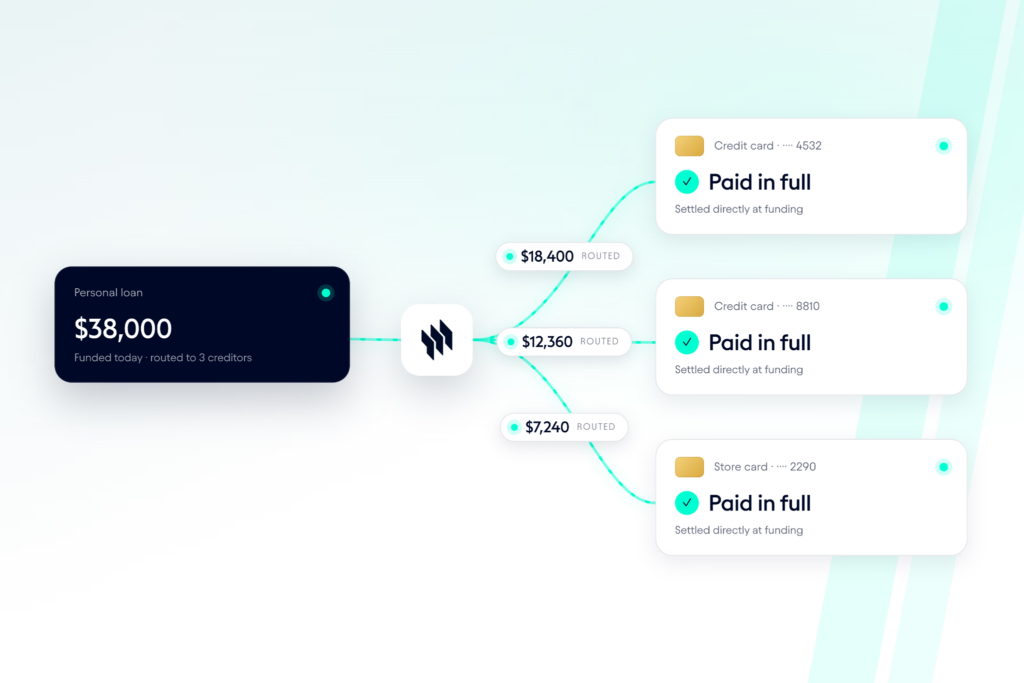
Instead of disbursing loan proceeds into a checking account and hoping they make it to the right places, modern direct pay solutions (like the one offered by Method) identify the borrower’s existing liabilities, confirm what’s actually owed on each one, and route the money straight to the creditors at funding.
The borrower never touches it.
Let’s walk through how direct pay works mechanically, step by step:
- Identification. The consumer provides a small amount of identifying information — name and phone number. That’s it. No other PII, no account numbers, no usernames, no passwords, no logging into each card issuer one at a time. The identity is matched against a network of connected issuers and servicers and returns the borrower’s payable liabilities: Which accounts exist, who services them, and which of them can actually be paid off through the network.
- Permissioning. The consumer authorizes their liability data to be shared. The permissioning language is embedded directly within the lender’s own terms and conditions. No third-party modal, no separate account to create, no unfamiliar second brand introduced mid-application. Consent is granted once, inside the flow the borrower is already in, and it can be scoped either to the single transaction or to an ongoing data relationship.
- Confirmation. Knowing that a borrower has a Chase card serviced by Chase is not the same as knowing what it will cost to close that account today. As I noted above, credit bureau balances are stale and don’t include accrued interest. So the payoff figure is retrieved directly from the servicer, for each selected account, at the moment of the request.
- Payability Check. Before paying, the lender must confirm the payment will actually land. This requires a directory mapping each institution to the payment and bill-pay rails that reach it — typically 90,000 to 200,000 institutions (Fiserv CheckFreePay, FIS BillPay, Visa Direct, Mastercard RPPS, etc.) — plus a check that the loan has not moved to a new servicer or shifted into collections, where payoffs are more complex.
- Settlement. Once payoff amounts are confirmed and the loan funds, the money moves. The payment is tokenized rather than executed against raw account credentials, and the token is validated against the accountholder in real time immediately before release. Payments are tracked all the way through the process, from pending to posted.
The result is a personal loan that actually results in the action (full debt paydown) that the borrower intended.
Pretty Sure Means No
It’s worth asking whether all of that effort I just described is actually worth it.
Thousands of servicer integrations. Payoff figures retrieved account by account. That’s a great deal of unglamorous work to improve on data that the credit bureaus already provide in roughly the right shape. The credit bureaus will tell you that a borrower has a Chase card and approximately what’s on it. Why does the last mile of precision justify the expense?
The answer has less to do with the data than with what sits downstream of it.
In lending, “I’m pretty sure” is functionally identical to “no.”
Underwriting is binary. You extend the credit or you don’t. There is no such thing as an 85%-approved loan. Payment routing is binary too. The money arrives at the servicer or it doesn’t.
Because the actions built on top of the data are thresholds rather than dials, the value of additional confidence isn’t linear. Below the threshold, better information buys you almost nothing, because you still can’t take the action it would inform. At the threshold, the action switches on.
The last few points of certainty are worth more than all the points that came before them.
This is the part I think gets consistently missed in conversations about data quality, and it explains why “credit bureau data is good enough” was never really an argument.
Good enough for what?
Good enough to establish that a tradeline exists? Absolutely.
Good enough to fully pay down the debt, or to underwrite against a debt reduction that hasn’t happened yet? Not close.
Same Criteria, Better Data
But what happens when the data that lenders are working off is good, not just “good enough”?
Two lenders have detailed results from implementing Method’s direct pay solution: SoFi and Figure.
Both are useful, and they’re useful in different ways, because they wired the same infrastructure into different parts of their process and got different returns as a result.
SoFi is one of the largest digital consumer lenders in the country, and debt consolidation is the dominant use case in its personal loan book. But SoFi’s version of the last mile problem is a particularly thorny one, because a meaningful share of the debt its borrowers want to consolidate isn’t credit card debt at all. It’s other installment loans, private student loans, the sorts of obligations held by servicers that never built an electronic remittance path in the first place.
This is the corner of the market where the paper check still rules.
Before implementing direct pay, SoFi put the responsibility for completing those payoffs on the borrower. Borrowers had to track down account numbers, servicer details, and billing addresses, then make sure the funds reached the right place. The process was manual, error-prone, and easy to abandon. And SoFi had limited visibility into whether the borrower paid off the loan.
Building Direct Pay internally would have meant integrating with thousands of servicers, including many that still accept only paper checks. SoFi would have needed infrastructure for printing, mailing, and tracking those payments, along with processes for handling checks that were delayed, lost, or misapplied.
After implementing Method’s Direct Pay solution, SoFi’s payoffs are now routed to verified servicer accounts automatically at funding, and the borrower gets a confirmation instead of a waiting period. SoFi implemented it after the underwriting process. The loan gets approved using SoFi’s normal risk criteria. Then, at disbursement, borrowers are offered a rate discount in exchange for letting SoFi send the proceeds straight to their creditors rather than into their checking account.
It’s a clean trade. The borrower gets a lower rate. SoFi gets certainty that the loan did the thing the application said it would. And the reported result is impressive: 20% more borrowers qualifying for a rate discount.
Figure went further.
Figure, as I’m sure you already know, is a digital lender and blockchain-based infrastructure provider, focused on unlocking consumers’ access to lower-cost loans, secured by the equity in their homes.
As I mentioned earlier in this essay, Figure is a conservative lender. Prior to implementing Method’s direct pay solution, Figure would only approve consumers for loans after excluding the consumers’ intended debt repayment targets from their debt-to-income calculations. The borrower did not get extra credit for their intention to use the loan proceeds to pay down their existing debts because Figure couldn’t verify that the borrower’s intention had been converted into action.
With Method’s direct pay solution in place, Figure now can. Borrowers can select which credit card, personal loan, or auto debt accounts they want to consolidate, view real-time calculations of their updated monthly payments and interest savings, and authorize disbursement directly to those creditors upon funding. DTI is computed against the post-consolidation reality rather than the pre-consolidation reality. The borrower gets credit, inside the model, for a debt reduction that is now certain to occur, because the lender is the party executing it.
This is the value of going that last painful mile to achieve certainty. Figure didn’t loosen its underwriting standards. It didn’t adjust a score cutoff, expand its credit box, or accept more risk in exchange for more volume. It’s the same risk criteria … with better data.
And the reported results are compelling: 2x funded conversion, 11% higher median loan value, 3% more pre-approved offer volume, and 50% lower 60-day delinquency across the first six months. Borrowers saw average monthly payment reductions of roughly $500. And Figure has been able to roll this out across its network of lending partners.
This combination of results doesn’t happen very often. Funded conversion doubled. Median loan sizes went up. And 60-day delinquency was cut in half. Under ordinary circumstances those results trade off against each other. Approving more borrowers and lending each of them more money is one of the more reliable ways to buy yourself worse credit performance. Getting all three to move in the right direction simultaneously, with no change to the underlying risk criteria, shouldn’t be possible.
But it is … when you have better account connectivity.
A Rising Tide
As impressive as these Direct Pay case studies are, better account connectivity and, ultimately, better data doesn’t stay contained to the problem it was purchased to solve. In consumer lending, certainty is a rising tide. It lifts all boats, and it prepares lenders for shifts in the competitive environment that are already underway.
Two examples.
Acquisition
Installment lending has always been a volume business, but the economics are moving. Unsecured personal loan originations grew nearly 20% year over year in TransUnion’s most recent data, fintech lenders continue to take share from banks, and the cost of acquiring a borrower keeps climbing.
When acquisition gets expensive, the value of a customer you already have rises relative to the value of one you have to go buy. Retention stops being a nice-to-have and starts being the whole game.
Which is inconvenient, because installment lending is structurally terrible at retention.
Consider the shape of the product. The lender underwrites once, disburses the money, and then collects an ACH payment on the fifteenth for the next 36 months. There’s no deposit account throwing off a daily signal. No card generating transaction data. No servicing interaction beyond a payment that clears automatically and invisibly.
The lender’s picture of the customer freezes at origination, and then it decays.
So when that borrower is ready for their next thing — a second round of debt consolidation, a home improvement project, a mortgage — the lender that already has the relationship is competing on approximately the same information as every lender that doesn’t. Which is to say, the consumer’s credit report.
This is where the work needed to enable direct pay pays an unexpected dividend.
Direct pay is one of the only moments in the entire installment lending workflow where a consumer has an obvious, self-interested reason to grant a lender access to their liability data. The borrower wants the payoff to happen. Permissioning access to their liability data is how they make that happen, and, crucially, that permission can be scoped to go beyond that debt payoff transaction.
A lender that keeps that consent alive knows what its customer owes, to whom, at what rate, and how all of that is changing — continuously, rather than at whatever interval it’s willing to pay a credit bureau for. That lender can make a relevant offer at the moment it becomes relevant, instead of sending a refinance email to its entire book and hoping something lands. Figure, for example, has seen a 50% increase in follow-on lending to existing customers since implementing Method’s Direct Pay solution.
Method just launched a new product — Portfolio Intelligence — which is designed to facilitate these exact types of post-origination outcomes by enabling lenders to continuously monitor their customers’ real-time liability data, with their customers’ permission.
Agents
The second shift is the one everyone is already talking about: Agentic AI.
One of the most intriguing promises of agentic AI in financial services is that it will help to close the intention-action gap that I described at the beginning of this essay. A meaningful portion of that gap is soft. It’s tedium, inertia, distraction, the friction of logging into a fifth servicer portal on a Tuesday night, the psychological pull of a large sum of money sitting in a checking account for a few weeks.
Those are human failure modes. An AI agent doesn’t have them.
An AI agent doesn’t get bored on the fourth account. It doesn’t rationalize leaving the last card until next month. It doesn’t spend the money on a vacation because the money was right there.
So the soft causes of the intention-action gap largely go away.
What’s left are the hard causes. The mechanical ones. And they don’t get easier. They get more exposed, because they’re the only thing still standing between intention and action.
An AI agent can’t act on “I’m pretty sure” any more than a human can. Arguably less. A human borrower looking at a payoff quote can notice that the number seems off and pick up the phone. An agentic system executing against a stale credit bureau balance simply executes, and then fails quietly, in a way that surfaces three weeks later as an account that never closed and a credit report that never changed.
Autonomous finance doesn’t need better dashboards. It needs the ability to do things, verifiably, on a consumer’s behalf. An AI agent that can see your debts but can’t act on them is a PFM tool dressed up as a chatbot.
The through line between these two examples is that both reward the same investment.
A lender that invests in consumer-permissioned liability infrastructure in order to make debt consolidation work correctly ends up with unexpected competitive advantages, like a durable data relationship with the customers it already has and the mechanical reliability that agentic AI is going to demand.
That’s what a rising tide looks like in practice. The certainty you build to solve the problem in front of you turns out to be the capability you need for the problems you haven’t met yet.
About Sponsored Deep Dives
Sponsored Deep Dives are essays sponsored by a very-carefully-curated list of companies (selected by me), in which I write about topics of mutual interest to me, the sponsoring company, and (most importantly) you, the audience. If you have any questions or feedback on these sponsored deep dives, please DM me on Twitter or LinkedIn.
Today’s Sponsored Deep Dive was brought to you by Method.

Method empowers lenders, fintechs, and other FIs to build products that unlock a level of autonomy never before seen by consumers. They’ve helped 45M+ users connect liability accounts and facilitated billions of dollars in repayments.
