Plaid vs. FICO and the Credit Bureaus
Happy Friday, Fintech Takers!
Well, the first full week of October is in the books. I trust that it was productive for you!
One more week until Money20/20. Back into the breach, dear friends! If you’ll be attending the conference (or hanging out in the lobby), let me know. It would be great to say hi in person!
Ohh, and also, I’ll be in San Francisco later that same week (10/21 - 10/23)! I don’t make it out to the Bay Area very often and I’d LOVE to meet with folks in person. Let me know if you’re interested!
- Alex
Plaid vs. FICO and the Credit BureausCopy anchor linkCopied
It’s been a very bad month for FICO and the credit bureaus, thanks, primarily, to Bill Pulte’s obsessive focus on breaking the FICO Score’s monopolistic hold over the U.S. mortgage market.
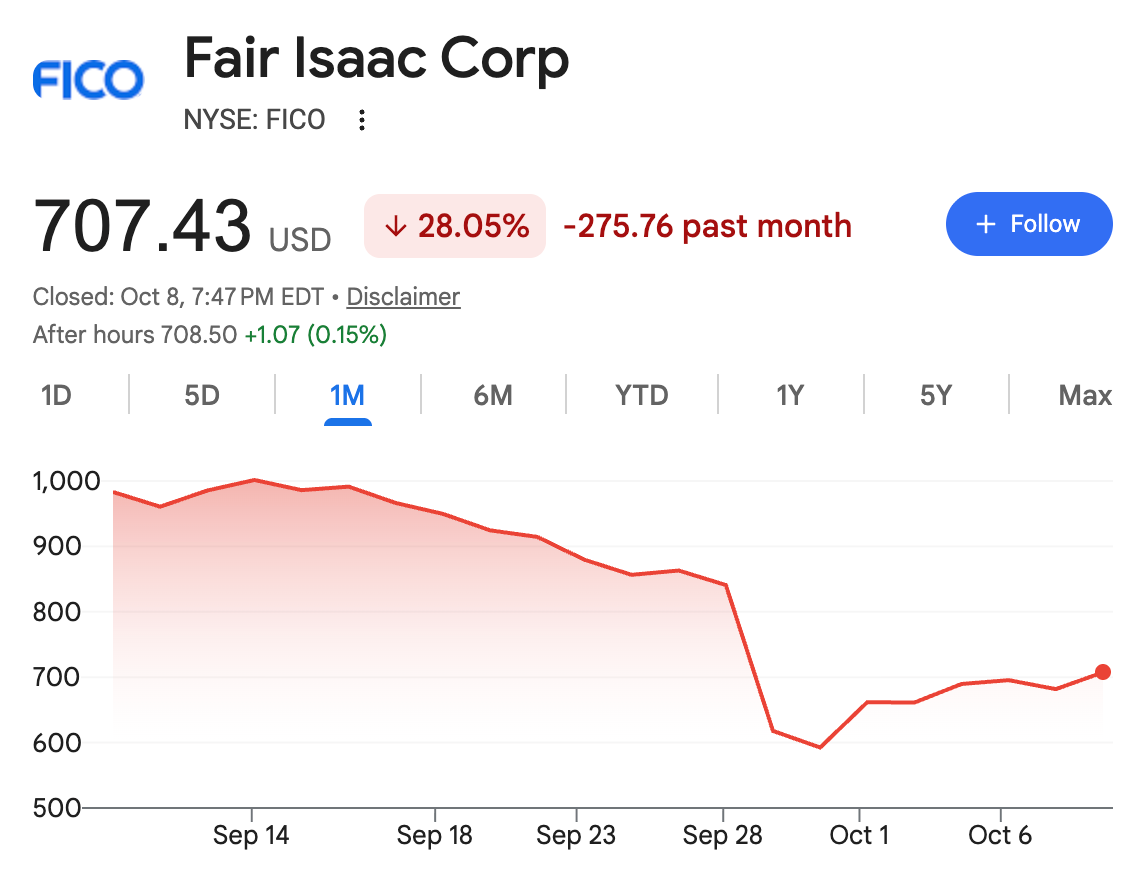
His efforts, which included a significant change to mortgage credit score pricing, have obviously been very bad for FICO. The company just laid off 15% of its global workforce1 and is dealing with a severe downturn in its stock price:
However, they’ve also been bad for the big three credit bureaus, which are kinda like the dogs that caught the car after successfully disrupting a product that they had been reselling, for decades, at a 100% markup and kicking off a frenetic pricing war for mortgage credit scores:
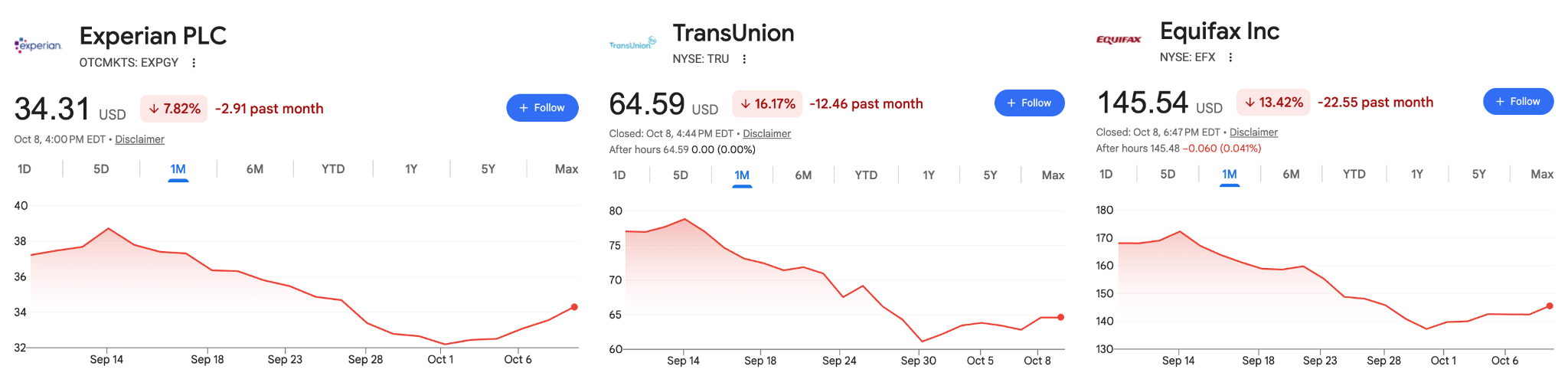
This entire series of events was extremely predictable2, but the fast and chaotic way in which it unfolded (the Bill Pulte Effect!) has caught many by surprise. It has also created a sudden and very compelling opportunity for new providers to step in and take market share, and I want to talk about one company that is making a strong push in this area: Plaid.
Plaid Has Been BusyCopy anchor linkCopied
In contrast to FICO and the credit bureaus, Plaid has had a very good month. In fact, just this week, the company announced a slew of new products and capabilities. The company reframed itself from the network that moves financial data to the one that interprets it, with a single sequential AI foundation model now sitting under nearly every risk product it sells.
That architecture choice matters because transformers were built to read human language — where a word’s meaning depends on the words around it — and it turns out financial services data (such as bank transaction data) behaves in much the same way. It has a similar syntax. The same $500 transaction can mean very different things depending on what came before and after it, so a sequential model learns the patterns of timing and order playing out across an account over time, rather than just scoring and categorizing transactions one at a time the way data aggregators traditionally have.
On the lending side, Plaid’s headline announcement was Instant Link, which decouples cash-flow data sharing from the point of application. A consumer permissions their data once through Plaid’s consumer reporting agency, and on a later application the lender passes a few basic identifiers to get network insights back in under two seconds. Alongside it came LendScore 2, a new family of credit models spanning an upgraded general-purpose score, three specialized versions tuned for auto, home lending, and short-term lending products, and LendScore Arc, a transformer-based model that is being launched in beta for evaluation and that is trained end-to-end on bank transaction data.
The through-line is that Arc and the rest of the models aren’t separate launches but adaptations of the same pretrained sequential model, so improvements to the foundation layer propagate across products without integration work.
For example, the same sequential model has been extended into Signal, Plaid’s ACH return-risk engine, and into Guaranteed Payments, which backstops settlement on approved transactions. It also upgrades Cash Advance Index — Plaid’s risk model for cash advance and earned-wage-access providers — so it now reads repayment behavior as it develops across pay cycles rather than scoring a single snapshot.
What strikes me as interesting, across all of these announcements, is how well-calibrated they are for competing, very specifically, with FICO and the credit bureaus. These calibrations, combined with the structural advantages of consumer-permissioned financial data and some product and infrastructure choices that Plaid made early on, put the company in a compelling competitive position.
Addressing Weaknesses and Building StrengthsCopy anchor linkCopied
You already know some of the advantages of consumer-permissioned financial data, relative to traditional credit bureau data, so I won’t restate them in depth. Compared to bureau data, consumer-permissioned financial data is fresher (because it runs in real time rather than monthly batches), analytically orthogonal (because it’s centered on ability to pay rather than willingness to pay), and more comprehensive (because more people have bank accounts than have active credit histories).
Let’s spend more time on the comparative strengths and weaknesses that are less obvious.
#1: Data Quality and CoverageCopy anchor linkCopied
Credit Bureau Weakness: Data quality and coverage has become a bigger and bigger issue for the credit bureaus over the last couple of decades, for a few different reasons. First, all three companies have, over that time, become much less diligent at ensuring that only authentic and useful data is being furnished to them.3 Second, it has become increasingly clear that fintech lenders value their proprietary repayment data very differently than bank lenders traditionally have, and are not always keen to share it with the credit bureaus (and embrace the responsibilities of being a furnisher) for free.
How Plaid Compares: All open banking data aggregators, including Plaid, have an inherent advantage when it comes to data quality: The data in question comes straight out of banks’ ledgers. To paraphrase one of my favorite Seinfeld jokes, if the data that your customers are sharing with third parties (through aggregators like Plaid) is incorrect, maybe open banking isn’t your biggest problem right now. And when it comes to coverage, Plaid specifically has been aggressive at continuing to maintain and expand the scope of the data it facilitates access to, striking a deal to pay JPMorgan Chase for data and, more recently, adding support for Fidelity.
#2: Modularity vs. Vertical IntegrationCopy anchor linkCopied
Credit Bureau and FICO Weakness: When the credit bureaus and FICO were making foundational decisions about how their core products should work (back in the 1970s and 80s), they didn’t have a lot of competition. FICO was the only provider of a general-purpose consumer credit score (released in 1989) and the big three credit bureaus had formed after decades of regional consolidation, giving each of them their own geographic kingdom to lord over. As a result, they never considered the strategic risk of making their core products — credit files and credit scores — functionally similar and interoperable.4 This similarity and interoperability has been a gift to lenders, which, historically, used it as leverage to negotiate lower prices with the bureaus (give me the price I want or I’ll go to one of the other two), and, now with the end of FICO’s mortgage monopoly, they are using it to do the same thing in credit scoring.
How Plaid Compares: Plaid has never been under the illusion that its core asset (consumer-permissioned financial data) isn’t a commodity.5 Because of this, Plaid has taken a much more vertically-integrated approach to building out the product suite on top of that core data asset. Specifically, Plaid focuses a lot on the value of its “network insights,” the signals that it can glean about consumers’ behavior and risks from the way that they engage with various companies through the Plaid network. For example, with LendScore, Plaid purposefully bundled commoditized permissioned bank transaction data with proprietary network insights so the product only works as an integrated whole. You literally can’t buy LendScore without also buying Plaid data.
#3: FrictionCopy anchor linkCopied
Credit Bureau Strength: Whatever advantages consumer-permissioned data had in terms of data quality, freshness, breadth, and ability-to-pay insights, the bureaus have always held one trump card: Getting their data is effortless. A lender runs a single pull, the consumer does basically nothing (and may not even need to know it happened), and the data lands in the decision engine instantly. Cash flow data, by contrast, has historically required the consumer to stop mid-application, find their bank, log in, and authenticate. This level of friction kills conversion rates and gives lenders a perfectly rational reason to default to bureau data.6
How Plaid Compares: The new Instant Link product is engineered to neutralize this exact advantage by moving the friction out of the application entirely. Rather than asking the consumer to connect their bank account at the point of application, Plaid has them permission their data once, up front, with that permission retained by Plaid’s consumer reporting agency.7 On any later application — including with a different lender — the borrower doesn’t log in or authenticate again; the lender simply passes a few basic identifiers (name, address, phone), Plaid matches them to their existing permissioned profile in the network, and returns cash-flow insights in under two seconds. The effect is to make permissioned data behave like a traditional credit bureau pull: a frictionless, identifier-based lookup in the underwriting workflow, with no consumer drop-off.
#4: Go Where the Big Banks Aren’tCopy anchor linkCopied
Credit Bureau and FICO Weakness: The biggest lenders (the money-center banks, primarily) employ large, genuinely talented data science teams, and those teams tend to hold a deep (and not unjustified) conviction that no outside vendor’s model can beat the custom ones they build on their own proprietary data. When those banks do buy a FICO score or a VantageScore, they’re very often doing it because they have to — because the GSEs, the securitization market, or a regulator expects that score to be in the file — not because they believe it’s teaching them anything they couldn’t work out themselves. That’s a quietly dangerous position for an analytics company to be in: Your largest and most entrenched customers are also the ones least persuaded of your analytic value and most capable of replacing you the moment an external mandate loosens.
How Plaid Compares: Plaid, whether by design or by good instinct, isn’t wasting its energy trying to convert those big lenders. The most sophisticated, product-specific models in the LendScore 2 family are tuned for auto, home lending, and short-term lending, and those happen to be the exact consumer lending categories least concentrated among money-center banks and most populated by nonbanks, fintech companies, community banks, credit unions, and specialty lenders. Those are the lenders who will actually adopt a superior vendor model, because they don’t have an in-house team that treats “we didn’t build it” as a disqualifying objection.
#5: Fraud and RiskCopy anchor linkCopied
Credit Bureau and FICO Weakness: The credit bureaus and FICO have historically treated fraud and credit risk as separate businesses — different products, built on different data, sold to different buyers, often run by different divisions. You buy a credit score from one silo and an identity or fraud product from another, and the two don’t really talk to each other. That split might have made organizational sense back in the day. However, analytically speaking, it creates a big gap because some of the most important risks in lending live in the overlap between fraud and credit. First-payment default and synthetic identity fraud, in particular, are neither cleanly “fraud” nor cleanly “credit” — they’re both at once — and a company that looks at the two through separate products, on separate data, is structurally prone to miss things.
How Plaid Compares: Plaid is coming at this from the opposite direction. Its fraud product (Protect), its credit products (LendScore), and its payment risk products (Signal and Cash Advance Index) aren’t siloed business lines. They’re different products sitting on top of a common foundation-model layer, reading the same underlying stream of consumer-permissioned transaction data. That shared base is the entire point. A signal that matters for fraud in Protect and a signal that matters for credit in LendScore are being learned by the same model from the same data, so the view across the two is unified rather than stitched together after the fact. For the overlapping fraud/credit risks that the bureaus struggle with, that’s worth a great deal. It also means Plaid gets to treat fraud versus credit as a product-packaging decision rather than a data-and-infrastructure problem, which is a far more flexible place to operate from than maintaining two separate franchises and hoping they occasionally compare notes.
#6: Continuous ImprovementCopy anchor linkCopied
FICO Weakness: FICO has a structural problem that has very little to do with the quality of its data science (which continues to be exceptional) and everything to do with how its product reaches the market. Each FICO Score is a distinct, versioned model — FICO 8, 9, 10, 10T, and so on — and historically FICO didn’t even sell those models directly to lenders; it licensed them to the credit bureaus, who computed and resold the score to lenders. That created two compounding disadvantages. First, when FICO invested in a genuinely better model, it had almost no ability to make its users feel that improvement, because adopting a new version is a slow, friction-laden process that requires lenders, the GSEs, and the securitization market to re-validate and re-integrate — a cycle that routinely takes years, if it happens at all. Second, and more corrosively, because lenders only ever experience FICO as an opaque number arriving from a credit bureau — not as an evolving analytic relationship — it becomes very easy to look at that number and conclude, “I could build something at least as good as this myself.” Every year FICO can’t visibly demonstrate that it’s getting smarter is another year it nudges its most capable customers toward building their own models.
How Plaid Compares: Plaid’s architecture is almost the mirror image. Because every one of its risk products sits on a single, continuously improving foundation model, an improvement Plaid makes at the foundation layer propagates across its product suite without requiring customers to undergo a re-integration cycle; users feel the model getting better as a matter of course, not as a multi-year adoption project. And Plaid sells and delivers that model directly, as part of an integrated data-and-analytics product, rather than licensing an abstract score to a group of middlemen. The competitive consequence is the inverse of FICO’s: Instead of handing customers more and more reason to conclude they’re smarter on their own, Plaid is positioned to continuously demonstrate that its model is improving in ways a given lender’s in-house model is not, which is exactly the perception an analytics vendor needs to cultivate to keep from being insourced.
#7: IncumbencyCopy anchor linkCopied
FICO Weakness: Incumbency is, obviously, mostly a strength. Being the established standard is the entire basis of FICO’s franchise, which has been throwing off piles of cash for decades. However, incumbency also carries a specific and underappreciated weakness: When you are the standard, you are structurally disincentivized from doing anything too bold. The GSEs, regulators, and the capital markets rely on FICO precisely because it is stable, familiar, and predictable, which means FICO has the most to lose and the least room to experiment.8 It can’t, for example, credibly walk into the market with a radical, end-to-end neural network credit model explained by techniques nobody has blessed yet. The weight of incumbency — of being the trusted industry standard — doesn’t allow for it. The incumbent’s job is to not rock the boat, but “don’t rock the boat” isn’t an ideal posture to hold at a time when the underlying technology of your product category is being rewritten.
How Plaid Compares: Plaid is a big, highly visible company, but it doesn’t have a massive existing business in the risk space to protect. As such, it’s using its freedom to skate to where it thinks the puck is going. LendScore Arc is the clearest expression of this: An end-to-end transformer-based credit risk model that generates its explanations using the native techniques of this era of AI (integrated gradients), rather than the long-standing industry workaround of proxying a sophisticated model with an older, more familiar one just to produce reason codes everyone is comfortable with. That’s a very bold bet. In fact, it’s further out on the frontier than even very sophisticated fintech lenders like Affirm, which still translates its transformer-based risk model into a gradient-boosted model for decisioning in production. Plaid is wagering that, over the next couple of years, this transformer-native approach becomes the standard way credit risk gets evaluated and explained, and it wants to be one of the companies that helps define that standard rather than one scrambling to catch up to it.
Where We Go From HereCopy anchor linkCopied
It seems increasingly clear to me that one of the biggest opportunities in fintech right now is to build a viable alternative consumer credit risk stack to the one that Bill Pulte is currently applying a sledgehammer to.9 Plaid clearly sees that opportunity and is going after it. I don’t know how successful they’ll be, but here are a few questions to keep in mind over the next few years:
- Does Plaid make a big push to get LendScore more deeply embedded at Fannie Mae and Freddie Mac? It would seem like a good time, given this FHFA’s intense focus on credit score competition and the fact that it has been exploring the value of consumer-permissioned cash flow data in mortgage lending for a while now. Will we see something concrete happen in the next 18-24 months?
- Can Plaid figure out a way to extend the permissioning of cash flow data into the loan sales and securitization part of the lifecycle? This would, I think, be very valuable to investors in the secondary market.
- Will Plaid invest more in Plaid Portal? Today, it’s a consumer-facing dashboard for managing data permissioning. A necessary tool10, but not a strategic asset. However, consumer-facing tools for credit score monitoring, fraud monitoring and prevention, credit building, and financial product research and comparison are big business, especially for Experian. Might Plaid try to play a bigger role in this direct-to-consumer space? Might it try to create something of a hybrid between Credit Karma and the consumer-facing components of Block’s new Cash App Score?
- Will Plaid’s efforts at vertical integration jeopardize the company’s partnership with FICO? FICO just relaunched UltraFICO (the company’s scoring product that incorporates cash flow data) earlier this year, in partnership with Plaid (replacing Finicity). Notably, the relaunched product is not being distributed through Experian, which was a launch partner on the original 2018 version. I’m guessing that FICO chose not to include Experian this time around because they’re mad at them for finally breaking the FICO Score’s stranglehold on the mortgage market. But, if that’s the case, how long until FICO decides that its relationship with Plaid is more competition than cooperation?
- Will Plaid’s efforts at vertical integration drive other data aggregators deeper into the arms of Nova Credit? Nova is the only other company that I see in the space that appears to be trying to build an end-to-end, vertically-integrated alternative to FICO and the credit bureaus. The company is doing some really interesting work at this level, including partnerships with Block on the Cash App Score and Cox Automotive on an integration with Dealertrack. Nova Credit is a CRA, but it’s not a data aggregator. Instead, it integrates with various data aggregators (and can optimize the use of multiple aggregators). I wonder if Plaid’s efforts to build more vertically-integrated solutions on top of its core aggregation capabilities will push the other data aggregators (MX, Akoya, Yodlee, Mastercard, etc.) and Nova Credit closer together? Might Nova even consider buying one of them?
WHERE I'LL BECopy anchor linkCopied
I’m not tired. Why are you even asking me that? I don’t get tired. NO SLEEP TILL BROOKLYN!!!!
✈️ Money20/20 | October 18 – 21 | Las VegasCopy anchor linkCopied
Last year at The Venetian, so let’s make it count! For the first time in at least five years, I’m not speaking at the actual event. So I have some time to catch up with folks!
If you’ll be around on Sunday morning, come play/watch basketball. It’s healthy to get away from the Strip for at least a few hours!
✈️ AFC Policy Summit | November 17 | Washington D.C.Copy anchor linkCopied
One of the best possible places to go if you’re looking for dense and nerdy finreg conversations. Plus, somehow Phil Goldfeder manages to hi five or shake hands with every single person.
✈️ Fintech NerdCon | November 18-20 | San DiegoCopy anchor linkCopied
I’ll be flying from D.C. to San Diego (arrghhhh), but it’s worth it for year two of NerdCon! Plus, San Diego rules.
Thanks for the read! Let me know what you thought by replying back to this email.
— Alex
Footnotes
- I’m personally bummed about this. I worked at FICO and know some of the folks who were impacted. There’s some real talent now available and banks and fintech companies would be wise to shopping, right now. And if any FICO folks who were impacted are reading this and need help finding a new opportunity, please let me know! ↩︎
- Three years ago, I tweeted, “The FICO Score, as a mechanism for establishing a common understanding of a consumer’s credit worthiness, will be dead within the next ten years.” At the time, this take was almost universally considered insane. So … you know … how do you like them apples? ↩︎
- The fact that it took the bureaus as long as it did to kick Tomo Credit off as a furnisher is all the proof you need. ↩︎
- Credit files have long been commoditized because furnishers usually furnish to all three bureaus. And the FICO Score and VantageScore are very similar, functionally, to each other (even using the same scoring range). Plus, you can use a credit file from any of the three bureaus to calculate a score from either FICO or Vantage. ↩︎
- This may be a bit of an overstatement. It may have felt differently in the very early days, when screen scraping was a resource-intensive process and 1033 was only a glint in John Pitts’ eye. ↩︎
- As a result of this concern about friction, almost all use of consumer-permissioned cash flow data in loan underwriting today is concentrated in second-look underwriting, for applicants who can’t get approved using bureau data. From what I can discern, this is the number one problem that all cash flow underwriting providers are focused on fixing. ↩︎
- This approach to consumer permissioning would not have flown under the Biden Administration. However, Plaid and others see an opportunity, under the current administration and in the absence of revised rules for 1033, to try to steer market best practices in a slightly different, more industry-friendly direction. ↩︎
- The same thing is generally true for the credit bureaus, though, when it comes to credit scoring, they have had the opportunity to play the disruptor and have done some small things with VantageScore to push the envelope forward. However, those innovations have been, comparatively, minor, which makes sense given that the bureaus also have a lot to lose. ↩︎
- If you think I’m overstating this, check out Director Pulte’s Twitter account. Tweets like this one and this one and this one and this one suggest that this particular issue (for whatever reason) is personally very important to him. ↩︎
- I believe Plaid Portal was actually created as part of the settlement for a lawsuit that was brought against the company back in 2022. ↩︎