The CFTC regulates hedging, not sports gambling.
Happy New Year, Fintech Nerds!
I hope you had a safe and enjoyable New Year’s Eve, and 2026 is off to a terrific start for you!
While I am generally an optimist, I do think we have a few problems to solve in fintech this year, starting with prediction markets, which were (according to Bloomberg) the category of fintech (if we can call it that) that received the most investment last year.
It would be great for everyone (except investors in Kalshi and Polymarket) if the regulatory loophole that these markets have been exploiting to offer sports betting started to close this year. And that’s why I am delighted to bring you today’s guest essay, written by my bank nerd friend Todd Phillips (author of some other wonderful guest essays).
Todd’s essay explores the legal foundations of prediction markets, which are regulated (if we can call it that) by the CFTC as commodity exchanges, and makes a compelling case for why most event contracts built around sports are not, in fact, commodities.
I hope you enjoy it!
- Alex
DEEP DIVE
The CFTC regulates hedging, not sports gambling.Copy anchor linkCopied
By: Todd Phillips, Assistant Professor at Georgia State University’s Robinson College of Business.
You’d have to be living under a rock to not have noticed the proliferation of what looks like sports betting on federally-regulated prediction markets. This development threatens to turn a financial regulator into a gaming regulator, albeit without the tools necessary to ensure gaming is conducted in a safe manner.
For those who haven’t been paying attention, here is a brief explainer. The Commodity Futures Trading Commission (CFTC) regulates certain financial instruments known as derivatives, so-called because their value is derived from the value of something else. One subset of derivatives are event contracts, which require payment depending on whether an event has or has not occurred. Certain platforms that facilitate the trading of event contracts — colloquially known as prediction markets — have listed contracts that pay out based on whether certain sports-related events have occurred, such as which team won a football game or a game’s final score. When states have threatened lawsuits against prediction markets for violating state gambling laws, the markets have responded by arguing that state laws do not apply because the products are overseen by the CFTC. Litigation has proliferated.
In a newly-filed amicus brief, I argued to the U.S. Court of Appeals for the Fourth Circuit that the CFTC only regulates commodity derivative contracts that are usable for hedging financial or economic risks. To that end, if an event contract is not useful for hedging because, for example, there are only minimal or no economic consequences related to the underlying event, it may appropriately be considered a gaming product under state law. Because it’s quite implausible that the events at issue in most prediction markets’ sports-related contracts have substantive economic consequences, they likely shouldn’t be considered commodity derivatives.
In this piece, I summarize the arguments made by my brief and expand on it to advise states how to proceed. In particular, I argue that states should make clear which contracts they find objectionable, ask prediction markets to delist them, and plan to litigate if they continue to be traded.
Background on Commodity DerivativesCopy anchor linkCopied
Derivatives are a class of financial instruments whose value is derived from the value of something else. Futures, for example, are agreements to buy/sell something else at some date in the future, and swaps are agreements to exchange cash flows based on the value of a secondary source at specified intervals in the future. To illustrate, a future could provide that Party A agrees to sell to Party B 5,000 bushels of corn for $450 per bushel in eight months. The “something else” upon which derivatives are structured is known as the “underlying,” “benchmark,” or “reference asset,” and can be physical products (like bushels of corn), rates or indices (like the Secured Overnight Financing Rate), events (like whether Microsoft stock is trading above a certain price on a given date), or practically anything else that has a price or can be measured.
The CFTC regulates commodity derivatives, meaning that it regulates derivatives for which the underlying is a commodity. The term “commodity” is defined in the Commodity Exchange Act (CEA), and includes agricultural commodities like wheat, cotton, and rice; “all other goods and articles,” except onions and movie box office receipts; and all financial interests “in which contracts for future delivery are presently or in the future dealt in.”1 This includes so-called “excluded commodities,” a category that include currency and interest rates; macroeconomic, stock, and other indices; and — relevant here — other “occurrence[s]” that are “associated with a financial, commercial, or economic consequence.”
Congress endeavored to regulate commodity derivative contracts usable to hedge economic risks.Copy anchor linkCopied
Congress has decided that commodity derivatives “are affected with a national public interest by providing a means for managing and assuming price risks, discovering prices, or disseminating pricing information through trading.” It enacted the CEA and subjected these contracts to federal regulation because it found value in allowing real economy firms to “hedg[e] themselves against possible loss through fluctuations in price.”
The story of the CEA starts in the mid-19th century, which saw the birth of venues, known as commodity exchanges, where farmers and other commodity suppliers could sell their crops and products to wholesalers. To facilitate these transactions, the Chicago Board of Trade introduced standardized futures contracts that allowed for the delivery of a certain grade of grain at a certain location at a certain time in the future, but with a price set at the time the contract was entered. Other commodity exchanges soon followed with a variety of derivatives. These contracts allowed both commodity buyers and sellers to lock in prices for sales that would not be executed for some time, enabling them to hedge their risks that prices might rise or fall in the intervening period. Over time, these contracts evolved, from being physically settled (meaning physical delivery of the underlying assets) to being financially settled (meaning parties pay the difference between contract prices and market prices at the time of settlement).
As with any new financial innovation, problems arose. Some traders endeavored to manipulate grain markets through derivatives. Traders attempted to “corner” markets by purchasing a sufficient volume of futures contracts that would expire on certain dates, increasing grain prices and harming sellers who had shorted those contracts. The era also saw the rise of “bucket shops” selling derivatives contracts. These firms did not execute customers’ orders on the exchanges, instead taking customers’ funds and holding them “as a bet on future price changes.” That is, they would metaphorically stick customers’ funds in a bucket, rather than purchasing the underlying asset. If a customer’s purported purchase decreased in value, the bucket shop operator would keep the funds. If the customer’s purported purchase increased in value, the operator would abscond with the funds.
Various attempts were made to control manipulators and bucket shop operators. Exchanges restricted access to their quotations in an attempt to control the bucket shops, and states subjected these shops to criminal prosecution. But these various attempts were largely unsuccessful. States lacked the capacity to effectively regulate the trading on commodity exchanges, and courts viewed both exchanges and bucket shops as engaged in illegal gambling.
Although courts eventually agreed that exchanges could protect their price quotes, federal legislators did not believe that enough was being done to prevent derivatives traders from manipulating the prices of the underlying commodities. Recognizing that states and exchanges had failed to effectively police derivatives markets and that such markets benefit productive economic activity (and with the desire to stabilize agricultural prices that had recently fallen), Congress enacted the Grain Futures Act. The Act prohibited traders from executing futures contracts related to six identified grains unless they did so on an exchange designated by the Agriculture Secretary.
Congress ultimately recognized that the Grain Futures Act provided inadequate regulatory powers and left too many gaps and loopholes in its regulatory scheme, so it enacted the CEA. The CEA continued to prohibit futures transactions that did not occur on a designated contracts market while also regulating brokers and their interactions with their customers. To increase farmers’ hedging opportunities, the CEA also expanded the definition of “commodity” in the Act to include “wheat, cotton, rice, corn, oats, barley, rye, flaxseed, grain sorghums, mill feeds, butter, eggs and Solanum tuberosum (Irish potatoes).”
Though this was the first time Congress expanded the Act’s definition of “commodity,” it wasn’t the last. Congress has since expanded the Act’s definition to include “all services, rights, and interests,” with limited exclusions, and includes currency and interest rates; macroeconomic, stock, and other indices; and other “occurrence[s]” — that is, events — that are “associated with a financial, commercial, or economic consequence.” These non-traditional commodities are called “excluded commodities.”
Getting to this point has not been a straight line. Following an effort by the CFTC to regulate financial derivatives in 1998, Congress enacted the Commodity Futures Modernization Act of 2000 to, among other things, exclude from the CFTC’s jurisdiction derivatives in excluded commodities. Readers of a certain age will remember that this decision helped to precipitate the global financial crisis of 2007–08, and Congress subsequently undid much of that law with the Dodd-Frank Act in 2010, placing the regulation of derivatives in excluded commodities squarely with the CFTC.
Though the definition of “commodity” in today’s CEA is so much broader than its 1936 counterpart and the law applies to additional derivative contracts, the Act’s goal remains the same: To regulate the trading of commodity derivatives that allow economic actors to hedge their risks.
Because sports-related contracts are generally not usable for hedging, they’re generally not commodity derivatives.Copy anchor linkCopied
What constitutes a commodity is key to interpreting the CEA’s application. If a contract is based on a commodity, it’s in. If it’s based on something other than a commodity, it’s out. But despite how broadly Congress defined the word, not all events are commodities: Only an event that is “associated with a financial, commercial, or economic consequence” is considered a commodity.2 Moreover, this can’t be read as merely any financial or economic consequence, because then the CFTC would end up regulating contracts that aren’t practically usable for hedging. Without such a limitation, for example, wagers on sports offered by state-regulated sportsbooks could be considered swaps, and the CEA would prohibit sportsbooks from offering them. It’s absurd to interpret the CEA as subsuming practically all of sports gaming.
To avoid this result and preserve the CEA’s mission of regulating hedging instruments, courts should distinguish contracts that are truly expected to be useful for hedging from those that are not by requiring excluded commodities to have more than a de minimis level of economic consequence to economic actors and the economy. If it is unlikely that a listed contract will be useful for hedging because the economic consequences of the underlying event are so minimal, Congress would not have expected them to be subject to the CEA.
To understand the importance of this de minimis test, one need only compare Kalshi’s “Will <central bank> take <action> at <meeting>?” contract with any of its sports contracts. The events underlying this contract — whether a central bank has decided to raise, lower, or hold interest rates — have more than a de minimis economic effect because these decisions affect the rates at which financial institutions make loans. Accordingly, it is reasonably expected that this contract would be useful for hedging.
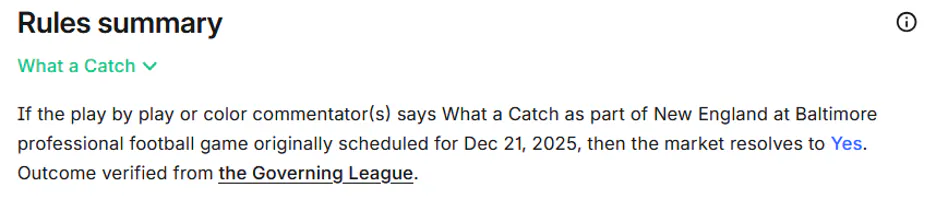
But it’s difficult to see how the events or occurrences at issue in sports-related contracts have more than a de minimis level of economic consequences, such that they’re usable for hedging. Personally, I don’t believe it could be the case that anyone will suffer some preexisting financial loss if an NFL team win a game, win a game by over 2.5 points, or score over 47.5 points in a single game — or if a television announcer says “What a Catch” during the game, which is literally a contract one can purchase on Kalshi’s platform:
The CEA does not preempt state law’s application to contracts that are not commodity derivatives.Copy anchor linkCopied
It is not the case that simply because a CFTC-registered prediction market lists a contract means states can’t regulate it. As discussed, the CEA gives the CFTC “exclusive jurisdiction” over commodity derivatives only, and the law expressly provides that, when the CFTC does not have exclusive jurisdiction, the Act does not “supersede or limit the jurisdiction at any time conferred on … other regulatory authorities under the laws of the United States or of any State.” As one court has noted, this “preserves the SEC and states’ regulatory authority over exchanges or transactions that are not covered by the CFTC’s exclusive jurisdiction.”
This limitation is important. Although the CEA allows prediction markets to list contracts for trading by self-certifying that they meet all applicable legal requirements (so long as the CFTC doesn’t stop them), these assertions may be incorrect. Imagine, for example, that a prediction market listed for trading a security (subject to the jurisdiction of the SEC and not the CFTC) but self-certified that the contract was actually a commodity derivative. Doing so would violate the Securities Exchange Act of 1934, which prohibits exchanges not registered with the SEC from listing for trading securities.
The same logic applies for other contracts, including those considered gaming under state law. Even if a prediction market self-certifies that a listed contract is a swap or another contract involving an excluded commodity that is based upon an occurrence, extent of an occurrence, or a contingency — that is, even if a market self-certifies that it has listed an event contract subject to the exclusive jurisdiction of the CFTC — a regulatory authority other than the CFTC may challenge that designation. To the extent that a listed contract is not subject to the CFTC’s exclusive jurisdiction, it may be subject to another law.
In a legal filing, Kalshi explains that “The CFTC has declined to subject Kalshi’s sports-event contracts to public-interest review, which reflects ‘the CFTC’s exercise of its discretion and implicit decision to permit them.’” The argument is, in other words, that because the CFTC let Kalshi list the contracts, they’re derivatives. But this can’t be the standard. Although the CFTC can reject prediction markets’ listing of the contract, its failure to do so (or even its explicit permission!) simply can’t allow markets to violate other applicable laws. What matters is whether a court finds any given contract to be a commodity derivative. The fact that a prediction market has self-certified a contract to be listed and the CFTC has given its approval (or non-disapproval) may create a presumption that the contract is a commodity derivative, but that presumption is ultimately rebuttable by the facts.
States’ Path ForwardCopy anchor linkCopied
States ultimately need to identify which contracts are commodity derivatives and which are not, and challenge in court the listing of contracts that don’t meet the mark. Presumably, states will challenge sports-related contracts, but there may be non-sports contracts that similarly don’t serve a hedging purpose. On the flip side, there may be certain sports-related contracts that can be useful for hedging, such as those related to the Super Bowl or other major events. For these contracts, Congress allowed the CFTC to decide whether or not these contracts should be listed.
One way to identify which contracts are which is for states to request the prediction market’s self-certification submissions. When a market self-certifies a contract for listing, it must submit paperwork to the CFTC. States should evaluate these filings to determine which they believe have real hedging purposes and which do not, ask markets to delist the contracts that lack such a purpose, and plan to challenge those contracts in court if they are not delisted.
ConclusionCopy anchor linkCopied
Congress saw derivatives as a means of helping farmers and other businesses hedge their financial and economic risks. It gave the CFTC the tools to regulate these instruments (though there can always be improvements). It didn’t give the CFTC the tools necessary to regulate pure gambling, including authorities to address problem gambling. Courts should recognize the difference.
Endnotes:
1: Congress added the exception for onion futures after two traders, Sam Siegel and Vincent Kosuga manipulated Chicago’s onion market. In the fall of 1955, they controlled 99.3% of the city’s supply, which they all at once flooded into the market to drive onion prices down, thus making their short position in the commodity extraordinarily profitable but driving onion farmers into bankruptcy. Congress subsequently enacted the Onion Futures Act in 1958. The prohibition against box office futures was added by the Dodd-Frank Act following lobbying by the Motion Picture Association of America.
2: Relatedly, although the CEA does not define the relevant parts of the term “swap” in such terms, swaps are effectively derivatives of excluded commodities. The Act defines the term in relevant part as a contract that “provides for any purchase, sale, payment, or delivery … that is dependent on the occurrence, nonoccurrence, or the extent of the occurrence of an event or contingency associated with a potential financial, economic, or commercial consequence.”
MORE QUESTIONS TO PONDER TOGETHER
Big news for the endlessly curious (yes, you): I’m collecting your fintech questions on a rolling basis.
What’s keeping you up at night? What great mysteries in financial services beg to be unraveled? Think of it this way, if a stranger is a friend you just haven't met yet, your question is a Fintech Takes conversation waiting to happen.
One that could headline a Friday newsletter or be answered in an upcoming Fintech Office Hours event.
Drop your question here, whenever inspiration strikes!
Thanks for the read! Let me know what you thought by replying back to this email.
— Alex
Join 2,444 other finance and fintech leaders in the Fintech Takes Network
The conversation doesn't have to stop here
Keep learning and connecting in the Fintech Takes Network
EVENTS | FEED | LIBRARY | DIRECTORY