An Agent Walks Into a Bank...
Happy Wednesday, Fintech Listeners!
There just aren’t any boring days with the AI labs.
And certainly there aren’t enough podcast conversations on AI and agentic finance, so I will attempt to remedy that today.
- Alex
P.S. — Money 20/20 is next week, so I imagine I’ll see many of you wandering the streets of Las Vegas!
If you find yourself in town early on Sunday, 10/18, join our group at UNLV for the annual basketball tournament.
About 100 people RSVPd, so even if you’re not playing it’s going to be a blast.
Hope to see you there!
3 BIG IDEAS FROM THE PODCAST
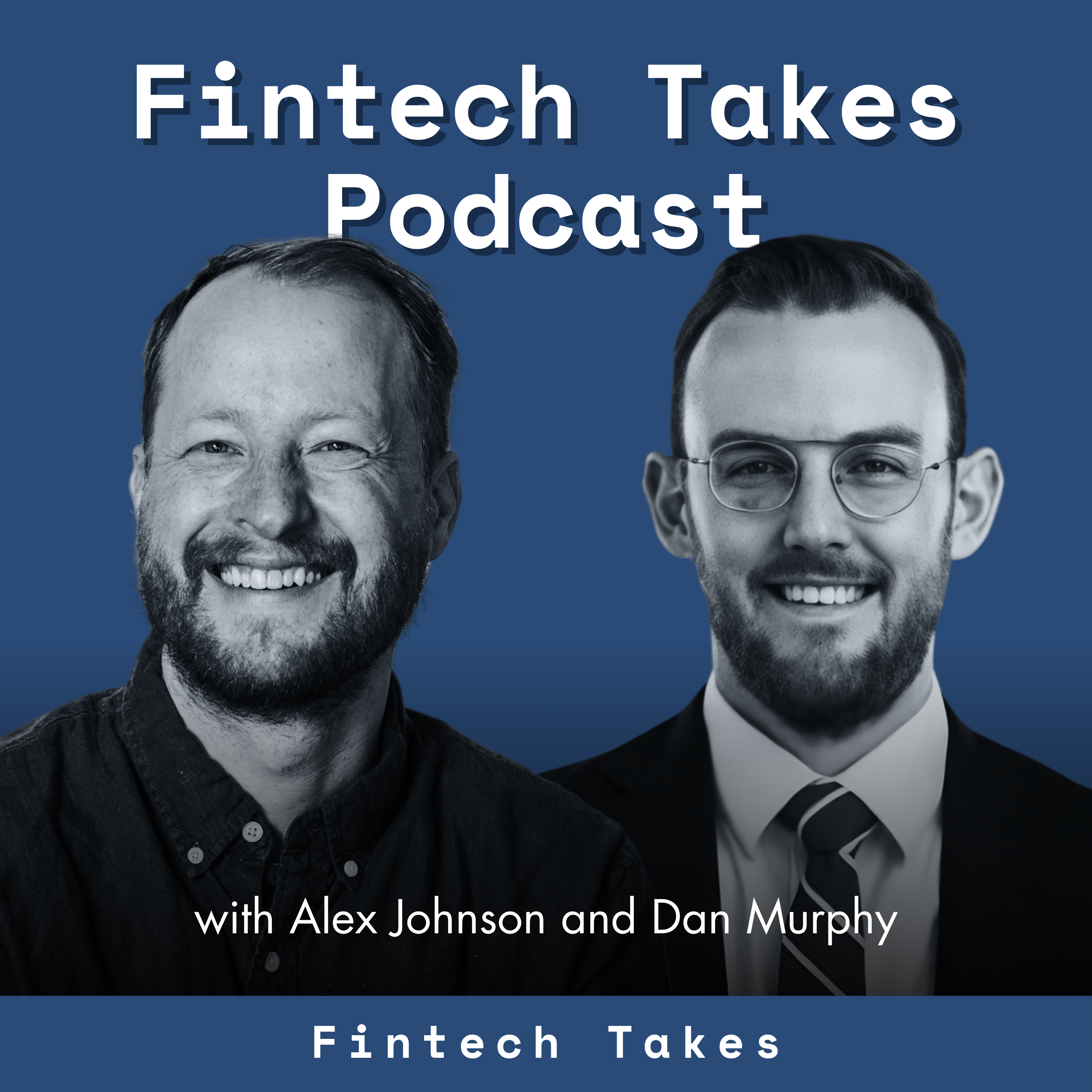
This week on the Fintech Takes podcast, Dan Murphy is back, this time as a partner at Allon Advisors.
Allon recently acquired Sunset Park Advisory, the fintech consulting firm Dan founded after working at the CFPB, where he helped shape the CFPB’s 1033 rule. He and Steve Boms, another friend of the show, are now working together under one banner.
I spent some time with Dan last month at the FDATA Global Summit in Toronto. The conference was about open banking, but agentic AI dominated the conversation. Watching screen-scraping veterans see AI agents logging into accounts was a little like watching soldiers realize the last war never ended.
In this conversation, Dan and I did what people with no regulatory responsibility do best. We conceptually followed an agentic transaction from identity through authorization and liability, all for your listening pleasure.
Tune in for the full conversation here
And read below for my three big ideas...
#1: Know Your Big Tech CompanyCopy anchor linkCopied
The banking industry has a newish acronym: KYA, Know Your Agent.1
This should concern you because we haven't figured out KYB yet (one can argue we suck at KYB, and the one arguing that is me). If KYB is still a mess, why should we feel at all confident about KYA?
Businesses are born, pivot, change their names, run divisions in six countries and hide behind complex ownership structures. Verifying them is document-heavy, and manual labor in every sense. Agents are an even flimsier abstraction; you can spin up a thousand of them and kill them the moment they stop being useful.
Dan offered a useful way to split that problem.
Your Muse agent may be hard to identify, but Meta isn’t. When an agent comes from a big company, there’s a corporate parent to hold accountable. On the other hand, open source agents like OpenClaw, the kind you install and run on your own devices, get a lot more complicated.
It reminds me of crypto, in a sense. Regulators can apply rules and legal pressure to a centralized exchange. A wallet on someone’s device, running on a blockchain, is much harder to touch. There's no obvious institution on the other end to hold accountable.
I half-joked that perhaps Big Tech will end up owning the whole AI market, leaving us with only six companies to diligence. That would certainly simplify things!
But Dan raises a more foundational problem. The U.S. lacks a unified digital identity layer, which would make it easier to bind an agent to the person or business it represents. He's profoundly skeptical we'll ever have one. As he put it, "Everyone read George Orwell and only George Orwell." It's un-American to have a government-run national digital identity system.
I fear that he’s correct.
So KYA inherits our already piecemeal identity infrastructure, with a potential consequence for competition: If financial institutions find it easier to verify and trust agents backed by identifiable corporate parents, what happens to everyone else? Who gets through the door?
#2: Permission Slip TimeCopy anchor linkCopied
Let's say a bank has successfully verified an AI agent's identity and established whom it represents. Great! Now, what’s that agent authorized to do?
Dan posed an even more interesting question: Who gets to decide?
He laid out four possibilities, each with rather different implications for the agentic economy:
- The consumer and their agent could establish the scope themselves, which is the option most open to competition and experimentation, though it leans hard on consumer consent.
- The merchant or bank on the receiving end could decide instead. There’s a real security case for that, and a commercial argument, too. This possibility would let a merchant prevent an agent from bypassing its ads or preferred payment methods.
- Then there are standards setters, particularly payment networks, whose immediate question is: “Okay, agents are transacting, but over whose rails?” Dan doubts competing payments players would ever agree on one standard, which is why so many keep multiplying.
- The last option, regulators, is one Dan thinks unlikely here anytime soon. Instead he pointed to the UK’s Variable Recurring Payments, Australia’s action initiation framework, and Brazil’s Pix Automático, which provide models for standing authorization bounded by payment amount, merchant type, or transaction frequency.2
Beneath all four possibilities, though, stands another complication.
For decades, we've used structured fields to establish what consumers want financial services to do. Agents increasingly interpret natural language instructions from folks typing hurriedly on their phones on the way to pick someone up at the airport. My agent, the company it's interacting with, and I could walk away with three different readings of what I authorized.
Dan’s fix: Scale the agent’s duties to its discretion and the stakes. A bad dinner recommendation is nothing. An agent that wants to pay a bill for more than I owe should check with me first.
Which brings us back to the permission slip. Whoever establishes the scope of authorization can influence which business models agents are allowed to challenge. But that framework also needs to account for the inconvenient fact that consumers don't express their intentions in neat, predetermined fields.
So before trusting any framework, ask two things: Whose business model is it protecting, and does its scope survive how people will actually use AI agents?
#3: Liability As the Mother of InventionCopy anchor linkCopied
One misconception I think we hold about liability in financial services is that it is, exclusively, a fight over who gets stuck with the bill after something bad happens.
But liability is also a way of influencing what happens before something goes wrong.
Dan and I got into this while discussing the UK's approach to authorized push payment (APP) scams, an area where British regulators have been more willing than their American counterparts to experiment.
The UK's Authorised Push Payment (APP) scam framework caps how much a customer can lose to a scam, while leaving them a little liability so they keep skin in the game (and the provider covers losses above that cap). And then it does something I find fascinating: It splits that provider-side liability 50/50 between the sending and receiving institutions.
Everyone hated it when it rolled out, of course. There were practical questions about how institutions would coordinate reimbursements and reconcile their obligations. But the early results, at least from what I’ve seen, appear promising.
And I think there’s a useful lesson here for agentic finance.
When we talk about scam prevention, we tend to focus on the institution sending the money. Why didn’t it catch the suspicious payment? Why didn’t it stop its customer from making a terrible decision?
Fair questions! But the bad guy had to receive that money somewhere. They opened an account at another institution and used it to commit financial crimes. Perhaps that institution ought to have a problem to solve, too.
Assign it half the liability, and suddenly it does.
Dan made another important point, which is that policymakers don’t have to stick the landing perfectly on the first attempt. He recalled how earlier European payment initiation rules evolved after frequent reauthorization requirements contributed to customer drop-off. Policymakers were able to learn from that experience rather than repeat it.
As we figure out agentic finance, I’d like us to remember both lessons.
Liability is the mother of invention. It’s remarkable what an industry can come up with once everyone has a financial incentive to prevent the same problem.
🎬 DIRECTOR'S COMMENTARY
On the podcast, I mentioned Matt Levine’s habit of finding the AI apocalypse in the boring parts of finance. His Money Stuff from a couple of weeks ago makes the point that most of what goes wrong with AI probably won’t look like a science fiction movie. It will look like hacked databases, fines, insurance claims and arguments over who pays. AI labs, he suggests, find the movie adaptation a lot more exciting to worry about than “liability allocation and insurance coverage.”
That’s Dan’s argument too. Finance is where AI first runs into real rules and real consequences, and where we’ll work out what an agent owes the person it works for, long before that question applies to anything else.
Dan also knocked on wood that Muse can’t kill him. Noted for the record.
WHAT I'M LISTENING TO
#1: Nubank’s Founder and CEO on taking Nu global (Brainfood) 🎧Copy anchor linkCopied
I absolutely could not stop comparing and contrasting Nubank’s GTM approach and Revolut’s GTM approach, after listening to this podcast and then seeing this interview with Revolut’s CEO.
What a study in contrasts.
#2: How to Win the Future of Fintech with Current CEO Stuart Sopp (Fintech Business Weekly) 🎧Copy anchor linkCopied
Stuart doesn’t do a ton of interviews. I’m glad he made an exception for Jason!
Thanks for the read! Let me know what you thought by replying back to this email.
— Alex
Footnotes
- For newcomers, we had a great event this past July on Know Your Agent: A New Problem for Old Defenses featuring Ross Freiman-Mendel (Head of Product Growth at Persona); Yuliya Kazakevich (Head of Risk and Compliance at Lithic); and Drew Edmond (Partner at Glenbrook Partners), which you can access on Finity here. ↩︎
- Dan admitted that he'd previously struggled to appreciate the value of some of this work. VRP sounded suspiciously like something we'd had for a long time called a subscription. Now, with agentic commerce, he gets it — and sees these frameworks as a working blueprint for a lot of what agentic commerce still has to figure out. ↩︎