How Do You Verify if an AI Agent is Acting as a Fiduciary?
In partnership with

Happy Monday, Fintech Takers!
I hope you had an enjoyable weekend, and if you have any particular rooting interests in the many different sports that are being played right now, I hope your teams are winning!
And if you like navigating through a foot and a half of snow, along with broken trees and downed power lines, in the middle of October (as I did while dropping my kids off at school this morning), I would highly encourage you to move to Montana!
- Alex
Sponsored by Plaid
Welcome back to Uncovering the Credit Blind Spot, where I'm pulling on different threads of the cash flow data lenders need to make smarter credit calls.
Lenders can't score the debt they can't see, and Plaid has the proof.
Those who added cash flow data to their underwriting run stronger portfolios, and they're becoming the norm.
93% of lenders are now expanding their use of alternative data, and holdouts are losing market share to these early adopters.
Datos Insights’ latest study found 74% of lenders are more confident in alternative data now than they were a year ago.
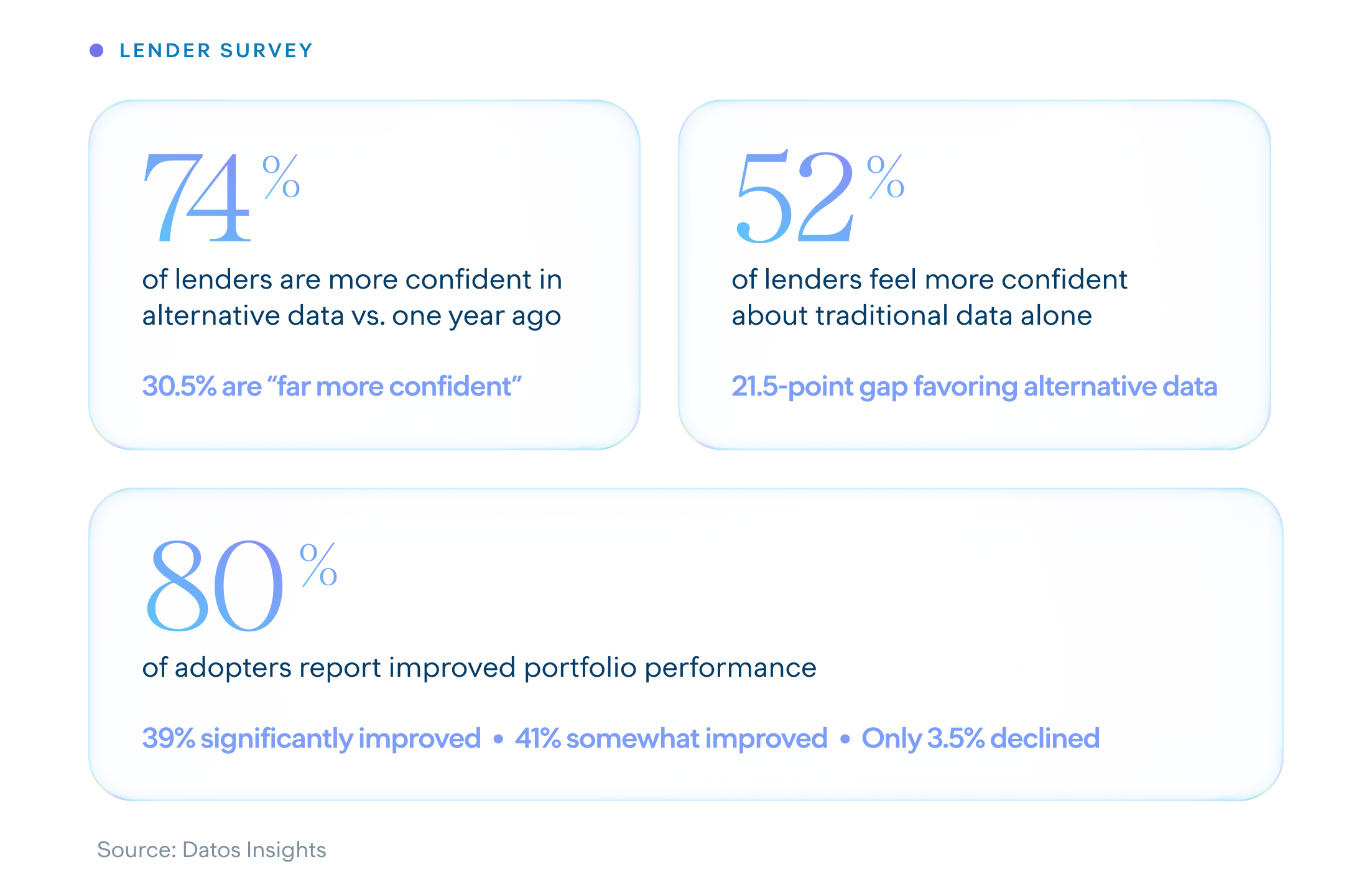
And the payoff is measurable: 80% of adopters report improved portfolio performance, and 39% call the gain significant.
Curious how to catch up?
Plaid and Tearsheet built a guide for exactly that.

3 FINTECH NEWS STORIESCopy anchor linkCopied
#1: Subprime Auto is Getting Too Hot to Touch Copy anchor linkCopied
What happened?Copy anchor linkCopied
Warning signs in the subprime auto lending industry are flashing red:
With more loans souring — one measure of delinquency rates has hit the highest since 2018 — the mechanics of the securitization machine and what it means for American consumers is even more important.
The playbook of Exeter — which Warburg Pincus bought from Blackstone Inc. in 2021 — has favored modifying loans through strategies such as interest rate reductions or, more commonly, extensions that tack missed payments to the end. The lender is now the second-biggest issuer of subprime auto loan-backed securities. In the data analyzed by Bloomberg, it modified almost two-thirds of its loans, more than its competitors, and was also more likely to change the same loan’s terms repeatedly, modifying nearly a quarter of them at least four times.
Meanwhile, Santander, the largest US subprime lender, modified its loans far less often, preferring instead to repossess the vehicles, selling them quickly to recoup as much of their value as possible.
Repossession can seem drastic and cruel, and desperate borrowers are often quite happy to defer payments or extend a loan if it means they can keep their car. At the same time, that can be a costly bargain: Loan modifications put borrowers at the mercy of lenders that control how and when to change the terms, sometimes significantly adding to the balance of the loan.
Snagging a tweak to a loan doesn’t mean borrowers are always able to get back on track. As of this summer, around one in four of the borrowers with a modified loan reviewed by Bloomberg lost their cars to repossession. Another 15% of those loans fell back into delinquency. For Exeter’s borrowers, closer to one in three modified loans still ended in repossession.
So what?Copy anchor linkCopied
Take some time to read the entire Bloomberg piece linked above. It’s really a work of art. The team did a great job on the reporting and on the construction of the interactive graphics illustrating the impact of different loan servicing strategies.
The basics of the story are as follows:
- Subprime consumers are more likely than the average consumer to need a vehicle to get to their jobs and, in many cases, to do their jobs. This means that these consumers are generally more desperate to get auto loans (and thus less likely to shop around for the best rate) and more desperate to avoid having their vehicles repossessed.
- Dealers that specialize in serving subprime consumers understand their customers’ desperation and will often capitalize on it by setting up arrangements with specific lenders that result in the dealers getting paid kickbacks for new loans.
- The market for asset-backed securities for auto loans, and, in particular, subprime auto loans, is extremely hot, and has been hot since the pandemic. This and other related private-market funding mechanisms have allowed nonbank lenders to significantly grow their share of the auto lending market (especially in subprime) over the last six years. Investors’ comfort with this asset class is buoyed by the simple fact that it has collateral (the vehicle) that can be repossessed and sold in order to offset investors’ losses. Persistently high prices in the used car market have helped further reinforce the value of this downside protection.
- Nonbank subprime auto lenders make money on the gain on sale when they sell their portfolios to investors, on the spread between the interest that they charge consumers and the interest they pay to investors, and on fee income earned from investors for servicing the loans.
- Some subprime auto lenders — Exeter, most notably — have significantly increased the rate at which they offer loan modifications to borrowers, which allow the borrowers to stay current on their loans when they miss payments, often at the long-term expense of tacking on additional fees and interest due to extended loan terms. Consumers are often willing to do this, despite the negative financial consequences, because they really don’t want their vehicles to be repossessed. And lenders like Exeter are eager to do it, despite the fact that these modifications frequently still result in the consumers ultimately defaulting on their loans, because it temporarily makes their portfolios look better to investors and they profit from being able to collect more interest and servicing fees in the interim.
All in all, very bad.
And I’m not really sure how it gets better.
Vehicle manufacturers keep raising the price of their vehicles because consumers will (with the help of lenders and their well-incentivized dealer partners) keep buying them. This helps keep the price of used cars high, which helps to offset investors’ concerns about the bottom falling out of the market, even as delinquency rates (particularly among subprime borrowers) continue to climb. This persistent investor confidence keeps the funding flowing to nonbank lenders, which are increasingly exploiting subprime consumers’ desperation to own functional vehicles by charging high interest rates and modifying loan terms after origination in order to keep the fee and interest revenue rolling in.
Something significant (more significant than the failure of Tricolor) is going to have to break and scare off these subprime auto ABS investors. Until then, I don’t see this market (especially given the absence of strong oversight from the CFPB) cooling off at all.
#2: How Do You Verify if an AI Agent is Acting as a Fiduciary? Copy anchor linkCopied
What happened?Copy anchor linkCopied
M1 announced an AI financial advisor:
M1 Advisor reads the balances, positions, and rates of all the accounts a client holds at M1. It can see cash, investments and borrowing. Clients can also connect outside accounts, such as a 401(k), an IRA, a mortgage, or a loan, through Plaid. Connected accounts give M1 Advisor a fuller picture when it advises on a client’s M1 accounts. M1 Advisor is non-discretionary, meaning it has no authority to act on its own. It answers questions and gives advice, and the client decides whether to act.
M1 Advisor is a fiduciary. M1 Advisory Services, LLC owes clients a duty of care and a duty of loyalty, discloses its conflicts of interest in writing through Form ADV Part 2A and Form CRS, maintains records of the advice it gives, and is subject to examination by the U.S. Securities and Exchange Commission.
M1 Advisor is available now in the M1 mobile app and at m1.com. Enrollment in M1 Advisor is opt-in. M1 Advisor is free for M1 clients through December 31, 2027.
So what?Copy anchor linkCopied
M1 is the second financial services company that I have seen launch an AI financial advisor that has a fiduciary responsibility to its users. Coinbase did something similar back in June.
It’s an interesting approach because it combines the legal status of an SEC-registered (and, in the case of Coinbase, NFA and CFTC-registered) advisor with the natural language UI and probabilistic reasoning capabilities of an LLM that, as Coinbase warns users, generates “outputs [that] are limited and may be inaccurate or incomplete and should not be your only source of information.”
So, the question is, how exactly can such a combination be considered a fiduciary, with a legal obligation to act in the best interests of its users?
Well, first of all, the term “fiduciary,” as defined under the Investment Advisers Act of 1940 is a lighter, more procedural thing than you might expect. It sounds like a guarantee of good outcomes, but it’s not. The duty has two prongs — care and loyalty — and under the SEC’s 2019 fiduciary interpretation, the loyalty prong is substantially satisfied by a full and fair disclosure of conflicts plus informed consent. “Act in your best interest” operationally means “don’t put your interests ahead of the client’s without disclosing the conflict and getting them to agree.” It’s a process standard, not an outcome guarantee.
How the SEC supervises that standard matters even more, because it’s indirect.
The Commission doesn’t pre-approve advice or grade recommendations by how they turned out. It reconstructs process from a paper trail, after the fact. An adviser files a form disclosing its conflicts; the compliance rule requires written policies and an annual review; the books-and-records rule preserves the communications and rationales that make the process auditable; and the Division of Examinations periodically pulls a sample of recommendations, tests them against each client’s stated goals, hunts for undisclosed conflicts or steering toward the company’s more profitable products, and then interviews the humans and asks them to explain themselves.
The entire apparatus assumes human judgment sits behind each recommendation, which an examiner can inspect and interrogate. The regulator infers fidelity to the process from the records and from being able to ask a person, “why did you recommend this?”
How does an AI agent fit into this paradigm?
For part of it, the agent passes … arguably better than a human. Every prompt and response can be logged, so instead of an advisor’s patchy notes you get a complete transcript of what the AI agent told each client. The registered entity still carries the duty and files its disclosure form, so the conflicts — M1’s economics on margin and borrowing, Coinbase’s on trading and crypto — disclose as cleanly as any human firm’s. And because the whole book is captured, an examiner could, in theory, test the entire population of recommendations for steering, not just a sample.
For the other part, it’s a much tougher fit. You can’t interrogate the judgment behind the decisions. There’s no one to depose, and the AI agent’s stated reasoning may be confabulated1, with the real drivers (training, fine-tuning, system prompt, whatever it’s optimized for) not inspectable the way a human’s reasoning is across a table. And the loyalty risk mutates into something that disclosures can’t solve for — not a stated conflict the client can weigh, but a subtle, personalized nudge toward the profitable action, delivered differently in every conversation. You can disclose “we make money on margin.” You can’t meaningfully disclose “in your particular chat, the model subtly steered you.”
Interestingly, the SEC saw this problem coming. In July 2023, under Gary Gensler, it proposed a rule to govern conflicts arising from “predictive data analytics” used in investor interactions. The core requirement in the proposed rule was unusual: Firms would have had to eliminate or neutralize those conflicts, not merely disclose them. This “beyond disclosure” posture was the point. The Commission had decided that for algorithmic nudging, disclose-and-consent — the very thing the loyalty duty rests on — wasn’t enough.
That proposed rule is gone. The SEC withdrew it in June 2025 under Paul Atkins, part of a sweep of fourteen Biden-era proposals, reverting to a “technology-neutral” view that the 1940 framework supervises the entity regardless of whether a human or an AI model is advising. This was a change that — you’ll be shocked to hear — the industry was very happy about. And it’s why M1 and Coinbase can describe AI agents as fiduciaries without having to meaningfully change the way they comply with that standard internally.
It remains to be seen whether consumers actually use these AI advisors on a large scale, and, if they do, how this technology-neutral approach to governing them ends up working out.
#3: These Are The Voyages Copy anchor linkCopied
What happened?Copy anchor linkCopied
The Department of Housing and Urban Development (HUD) is investigating Wells Fargo:
Wells Fargo is under federal investigation over mortgage programs designed to help Black Americans become homeowners, with the Trump administration examining whether the bank violated fair housing laws by offering favorable lending terms based on race.
In February 2017, Wells Fargo pledged $60 billion in mortgage lending to help create at least 250,000 Black homeowners by 2027. The commitment sought to expand access to financing in communities with historically lower homeownership rates.
The bank introduced another $210 million initiative in April 2022, including $150 million to help eligible Black homeowners reduce mortgage interest rates and refinancing costs. The remaining $60 million supported grants intended to expand homeownership opportunities in communities of color.
So what?Copy anchor linkCopied
As it relates to fair lending under the current administration, I’m honestly kinda shocked by how uninterested most people seem to be in the topic. Whenever I write about it, I feel like I’m just off by myself in deep space, staring into the void and recording my thoughts for posterity.
These are the voyages of the starship Fintech Takes. Its four-year mission: To explore strange changes to fair lending regulations, to seek out new lawsuits and new federal investigations, to boldly go where every other fintech newsletter is too bored to go!
Anyway, in keeping with the Star Trek theme2, I’ll break down this news by having two Star Trek characters who sit on opposite sides of the emotional spectrum debate it.
Spock: Doctor, let’s stick to the facts. The Equal Credit Opportunity Act (passed in 1974) explicitly authorizes lenders to administer special purpose credit programs (SPCPs) to meet "special social needs" or to assist an "economically disadvantaged class of persons." These programs are allowed to take otherwise-prohibited characteristics into consideration when making lending decisions.
A common characteristic that is used in these SPCPs is race, as racial disparities in access to credit and in homeownership continue to persist. In fact, according to the Pew Research Center, approximately 46% of Black households owned their homes in 2024, compared with 73% of white households.
Wells Fargo made a commitment in 2017 (under the first Trump Administration) to lend $60 billion to qualified Black consumers for home purchases by 2027. In 2022, it set up a $150 million SPCP to allow eligible Black homeowners to refinance their mortgages to lower rates. This came after the Biden Administration encouraged lenders (via interagency guidance) to use SPCPs to address the needs of “economically disadvantaged” communities.
The second Trump Administration has since worked to dismantle that framework. An April 2025 executive order directed agencies to deprioritize disparate-impact enforcement, and in April 2026 the CFPB finalized amendments to Reg B that do two relevant things: Declare that ECOA does not permit disparate-impact claims at all, and sharply restrict SPCPs created by for-profit companies. Under the amended rule, such a program may no longer use race, color, national origin, or sex as an eligibility criterion, and the creditor must show that each participant would have been denied credit outright — not merely offered worse terms — under the institution’s own standards absent the program. The rule specifies that this holds regardless of a program’s stated remedial purpose.
The second Trump Administration is now, more broadly, pursuing investigations into lenders that had made commitments, under the Biden Administration, to lend to historically disadvantaged groups. The Department of Justice recently investigated and then settled with PayPal. And now HUD is investigating whether Wells Fargo violated the Fair Housing Act, which does not have the same carveout for SPCPs that ECOA does (although regulators have consistently treated SPCPs as consistent with the FHA).
It would be inappropriate to comment any further on the matter until this investigation is concluded.
McCoy: My God, man. I’m a doctor, not a fair lending lawyer! You make it sound like there are two legitimate sides to this fight! ECOA explicitly allows SPCPs. That’s not something that the Biden Administration invented in 2022. It dates back to 1974.
And the $150 million that Wells Fargo committed to its SPCP was explicitly for the purpose of refinancing the existing mortgages of Black homeowners. They helped 5,100 customers refinance their loans, saving them an average of $100 per month. Compare that to 2020, when Bloomberg reported that Wells Fargo approved less than half of Black applicants for mortgage refinance loans during the refinance boom (versus 72% of white applicants). Is there anyone, anywhere, who genuinely believes that Wells Fargo didn’t move in a fairer and more economically productive direction over the last six years?
There’s simply no way that Wells Fargo violated the law here. And the reason I think that is that, in his statement, HUD Secretary Scott Turner said, “Even if Wells Fargo did not violate the law, its practice of dividing Americans based on race is immoral, unethical and un-American.”
Even if Wells Fargo did not violate the law? That’s what he’s saying in the statement announcing the investigation?!? You mentioned the DoJ/PayPal investigation, but you failed to mention that investigation was focused on fair lending, yet it was targeted at a $530 million investment and grant program. A fair lending investigation focused on a program that did not include any lending!
And PayPal settled the investigation. Because, in 2026, that’s what you do when the federal government is bullying you and you just want to make the bullying stop. And unlike under the Biden Administration, when bank trade associations absolutely howled about the unfairness of regulators (especially the CFPB) using its public platform to pressure and coerce the industry to do what it wants, I haven’t heard a peep from them when it comes to the same tactics being applied to fair lending and the current administration’s war against DEI.
Of course we can comment on this matter now. Are you out of your Vulcan mind?
2 READING RECOMMENDATIONSCopy anchor linkCopied
#1: The Last Deterministic Act (by Stuart Cook, Atomic Settlement) 📚Copy anchor linkCopied
Exceptional essay from Stuart on the last deterministic act in payments (and why it will be where the value accrues).
This line, in particular, was a banger: “Fedwire does not move money faster than a spreadsheet; it moves money in a way that everyone agrees happened.”
#2: Girls just wanna have fun (by Kristen Anderson, Skeptical Optimism) 📚Copy anchor linkCopied
Another wonderful newsletter (also published through the Finity platform!) Could not agree more with the sentiment, which can be summed up by this quote:
The opportunity [afforded by AI] is to learn ourselves and our personal values more deeply and exercise choice and autonomy for those values. Instead of thoughtlessly stripping away any activity that isn’t pure leisure, we can choose to enjoy something that seems a little mundane, a little inefficient, or a little frustrating.
*Bonus: Evaluating Identity Verification Partners? 6 Questions for Payments Leaders at Money20/20 (by Veriff) 📚Copy anchor linkCopied
A vendor that quotes a 99% deepfake catch rate but doesn't mention how many good users it blocks is only showing you one column of the P&L. Veriff put together six questions to ask identity vendors before Money20/20, each with the green flag and red flag to listen for. Read them before the show floor does the talking.
*This rec is brought to you by one of our fantastic brand partners.
1 QUESTION FROM FINITYCopy anchor linkCopied
There are a TON of interesting questions being asked in Finity (our digital community for fintech and banking nerds). I’ll share one question, sourced from the community, each week. However, if you’d like to join the conversation, please apply to join!
Is there a risk to consumer-facing banks and fintech companies leaning too hard into AI (and doing so publicly and loudly) and generating a backlash among their customers (who, according to polling, really don’t like AI)?
If you have any thoughts on this question, reply to this email or DM me in Finity!
Thanks for the read! Let me know what you thought by replying back to this email.
— Alex
Footnotes
- In human terms, confabulate means to unconsciously create, distort, or misinterpret memories (often due to brain damage, amnesia, or dementia) where the person genuinely believes the fabricated details are real, without any conscious intent to lie. In AI terms, it refers to moments when a computer model "hallucinates" or generates false, made-up information or details while trying to complete a response or story. ↩︎
- What is my ranking of Star trek TV shows?
You didn't ask, but I'm happy to answer anyway: 1.) Next Generation, 2.) Discovery, 3.) Voyager, 4.) TOS, 5.) Strange New Worlds, 6.) Deep Space Nine, 7.) Enterprise, 8.) Picard, 9.) Lower Decks, 10.) Starfleet Academy.
Strange New Worlds was much higher after just the first two seasons. I have never seen the original animated series or Prodigy. ↩︎