Engineered to Never End
Happy Friday, Fintech Takers!
Money20/20 is almost upon us! Rest those feet and save up your voices (and your luck, if gambling is your thing).
I’ll see you (probably while speed walking between meetings) next week.
We’ve published a lot of content this week — including (if I may say so) a rather excellent sponsored deep dive on stablecoins, yesterday. I don’t mean to add to your reading list, but I had a take on the Ramp vs. Mercury Twitter fight and Ramp’s new AI product and fundraise that I had to get off my chest.
I hope you enjoy it!
- Alex
Engineered to Never EndCopy anchor linkCopied
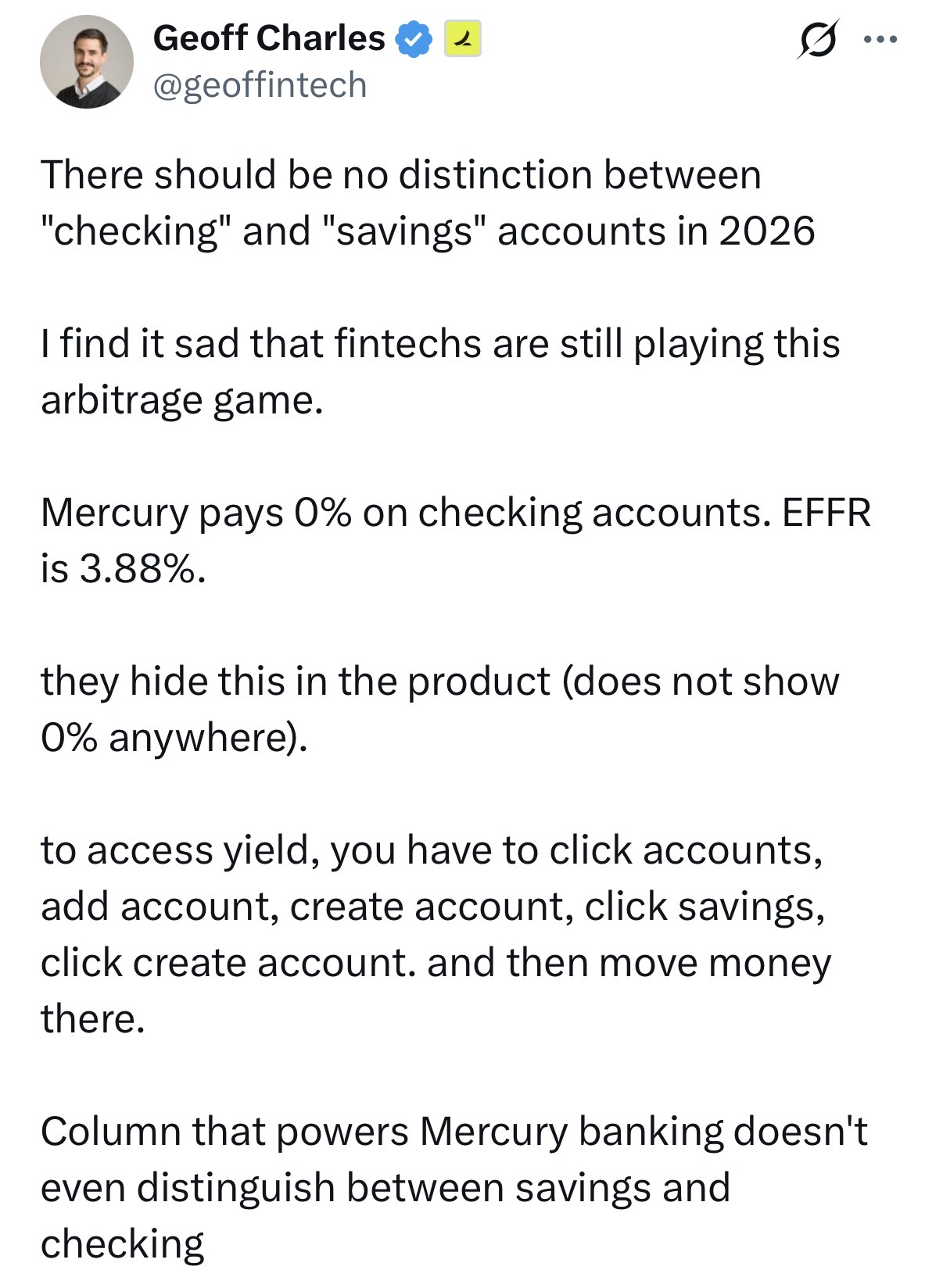
Geoff Charles, the Chief Product Officer at Ramp, tweeted this earlier this week:
A little while later, Immad Akhund, CEO of Mercury, replied:
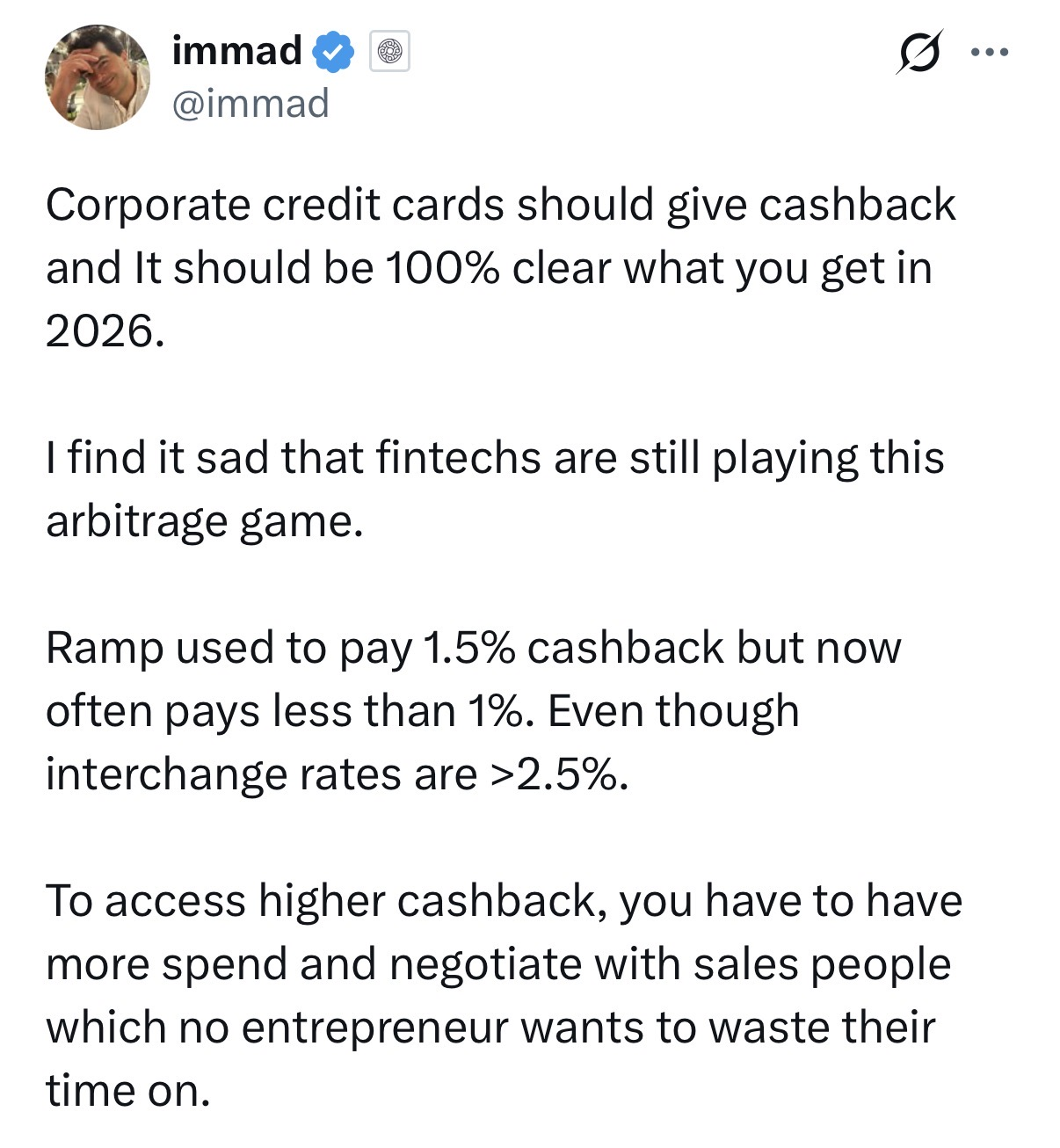
On a surface level, I found this back-and-forth entertaining in a “girls, stop fighting, you’re both pretty” kinda way.1 They’re both making the same essential point — that financial incentives distort customer-centric thinking and warp product design and pricing decisions — and I think both points are fair, though neither example seems especially egregious to me.
However, on a deeper level, I found myself sympathizing a bit more with Mercury than with Ramp, and I honestly wasn’t sure why.
So, I thought it would be useful to interrogate my feelings a bit more thoroughly.
FundingCopy anchor linkCopied
Here are some fun facts:
- In 2025, 33% of all U.S. VC dollars went to the top 1% of companies by valuation, up from 12% in 2022.
- In 2025, mega-rounds ($100M+) surged 77%, representing a total of $307B across 738 deals — 65% of all venture funding globally.
- In 2026 so far, 80% of U.S. startup investment has gone to rounds of $500M+, across just 29 companies.
- Unsurprisingly, AI took 48% of all venture dollars globally in 2025 and roughly 86% of U.S. dollars in H1 2026.
- Meanwhile, fintech funding fell for a third straight quarter to $11B globally in Q3'26 — its lowest since Q3'24 — on pace for $52B in 2026, down 14% from 2025. More significant than the dollar decline is the decline in the number of deals. We saw only 650 fintech deals in Q3'26, down 46% YoY and the fewest in more than four years.
- This reduction in deals can be explained, in part, by this rather startling fact: In Q3’26, mega-rounds were just 4% of fintech deals but 61% of funding, up from 46% a year earlier.
There is still a reasonable amount of money being put into early-stage fintech companies (though there are fewer such deals than there used to be and the amounts of each are higher than they used to be). However, your best chance of being able to raise money in fintech these days is to be: A.) An attractive, fast-growing, late-stage private company, and B.) Able to plausibly make the case that you are just as much (or more) an AI company than you are a fintech company.
We all understand why the market wants to give money to companies that can credibly claim to be AI companies, so I won’t waste column inches re-explaining that.
However, the first point — investors want to hand out mega-rounds to attractive late-stage private companies — is less intuitively obvious. After all, these rounds used to be where private market investors got hurt if they weren’t careful. You buy into a high-growth late-stage company and then watch the value of your equity get torched after the company goes public and public market investors start asking their annoying questions about operating margin and return on assets.
So, what’s changed?
Well, first, the quality of the companies soaking up these mega-rounds has gotten better. Not every late-stage company gets the privilege of raising $500M+ checks on demand. However, ironically, the ones that do usually don’t need to. They’re fast-growing, yes, but they’re also generally producing a lot of revenue. And if they’re not profitable, they are certainly within easy reach of profitability. This “I don’t need your money, but I’ll take it” status seems to be comforting to investors.
Additionally, early equity holders are now less desperate for a big exit. The entire point of an IPO or an acquisition, from an equity holder’s perspective, used to be liquidity. It was how investors turned a paper markup into actual returns they could send back to LPs and it was how early employees finally realized the benefits they had deferred by choosing to work for a startup. But the secondary market has matured to the point where that logic is no longer unassailable. Today, employees can get liquidity, early investors can get exits, and new investors can get in — all without the company ever going public. Once you can buy and sell a private company’s shares nearly as easily as a public one, the premium you used to demand for illiquidity shrinks, and so does the urgency to ever list or sell to an acquirer.
Finally, the capital itself has changed. The money flooding into late-stage rounds increasingly isn’t traditional ten-year venture capital that needs to return money on a clock. It’s crossover and evergreen vehicles built for long-term holding. Dragoneer — which co-led Ramp’s most recent $1.85B round — runs a $12B evergreen fund that holds private and public positions interchangeably with no fixed wind-down date. The latest fund raised by Thrive Capital (another co-leader in Ramp’s latest round) is $10B, structured as roughly $1B for early-stage companies and $9B late-stage companies. Sovereign and pension capital — GIC, Ontario Teachers’ Pension Plan — now shows up directly in these rounds rather than as LPs one layer below. This capital doesn’t need an exit to recycle. It would rather own a compounding private position for a longer period of time than force a listing and a tax event.
Taken all together, there’s never been a better time to run a late-stage, high-growth, revenue-generating company that has a plausible path to being a winner in the AI era. You don’t have to go public if you don’t want to (and given how annoying it is to be a public company, who in their right mind would want to?) Investors are begging you to take their money because you don’t need it. Your valuation is too high for any other company to be able to acquire you. And, as long as you give them stimulating problems to work on, your world-class employees are perfectly happy to stick around.
PayPalCopy anchor linkCopied
For all the reasons articulated above, it makes complete sense to me why the founders of attractive late-stage private companies are (if they have the option) choosing to stay private indefinitely. I get it.
However, I also think it’s fair to say that it’s not the best thing for the ecosystem as a whole.
There’s a natural lifecycle in venture-backed company building and the health of the overall ecosystem depends on companies moving all the way through that lifecycle.
PayPal is the archetypal example:
- 1998 — Max Levchin, Peter Thiel, and Luke Nosek found Confinity, which originally focused on security software for handheld devices before pivoting to online payments.
- 1999 — Elon Musk founds X.com as an online bank/financial-services company.
- 2000 — Confinity and X.com merge, forming the company that will eventually be called PayPal. Musk becomes the largest shareholder and CEO, but Thiel quickly replaces him as CEO.
- 2001 — The company raises a $90M Series D. In total, PayPal raised more than $200M as a private company.
- February 2002 — PayPal goes public in one of the last notable dot-com-era tech IPOs. Raises $61M and is valued around $800M.
- July 2002 — eBay announces that it is acquiring PayPal. All-stock deal, valued at $1.5B. Once the acquisition closes, a cohort of new millionaires is minted and, over the next couple of years, that group disperses, driven away by eBay’s overly slow and cautious corporate culture.
- 2014 — eBay announces it will spin PayPal back out, under pressure from activist Carl Icahn, whose thesis was that PayPal was worth more free than trapped inside eBay. At separation, PayPal’s market cap ($50B) exceeds eBay’s own. Today, PayPal’s market cap is, somehow, less than it was a decade ago (roughly $45B).
If you look at the story, solely through the lens of what happened to PayPal, it looks a bit like a tragedy. A once-great fintech company, acquired just months after going public and then mismanaged to the point where it is now a husk of its former, glorious self.
However, if you look at the story through an ecosystem lens, it’s undoubtedly a positive one.
This is true for the venture-backed tech ecosystem as a whole (PayPal founders and early employees went on to found Palantir, Tesla, SpaceX, YouTube, LinkedIn, and Yelp, among many others). However, it’s also true for the fintech ecosystem, specifically.
Max Levchin is the most obvious example. After PayPal, he built Affirm, which has become one of the largest and most successful fintech companies of the modern era. He has also invested in numerous fintech companies through his incubator HVF and his fund SciFi VC. But it’s not just Levchin. Elon Musk is still trying to make X.com the financial services powerhouse that he thought it could be back in the 1990s. And numerous PayPal founders and early employees have leveraged their time, money, and relationships to invest in fintech companies, including Thiel (co-founded Founders Fund and has backed Affirm, Stripe, and Ramp, among others), Keith Rabois (Khosla and Founders Fund … Ramp’s most ardent cheerleader), and David Sacks (Craft Ventures, backed Affirm, more recently a champion of the crypto industry).
Had PayPal not succumbed to the natural entropy that crushes and redistributes the talent and capital that successful private companies accrue … Well, I’m not sure what would have happened. It probably would have worked out better for PayPal, in that alternate universe, but I feel quite confident that the tech ecosystem as a whole, and the fintech ecosystem specifically, would have been the poorer for it.
The reason this matters is that there are a couple of late-stage private fintech companies that are effectively fending off this entropy. And while I understand and even admire their efforts in this regard, I worry about the effects that their success will have on the rest of the industry.
StripeCopy anchor linkCopied
Stripe is the prototype. It was founded in 2010 and is, undoubtedly, one of the most successful fintech companies (and tech companies period) in history. It reportedly generated $6.8B in revenue in 2025, which was a 33% increase over 2024, and seems to be picking up even more momentum in 2026. The company is privately held — having raised more than $9B over more than 20 funding rounds — and, according to its Co-founder and President John Collison, has no plans to go public. In fact, Collison told CNBC that, “For us right now, an IPO would be a solution in search of a problem.”
But what about Stripe’s early investors and employees? If Stripe doesn’t go public (and, at its current $159B valuation, it’s much too big to be acquired), how will those folks get taken care of?
Well, that’s where three of Stripe’s last four fundraising rounds come into play. In 2023, it raised roughly $6.5B in new funding (on a lower valuation) in order to cover a massive tax liability from expiring employee restricted stock units and to buy back shares from current and former staff. Then, in 2025 and early this year, Stripe arranged two secondary tender offers (both at higher valuations), funded by a combination of new outside capital from venture firms and the company’s own balance sheet, in order to provide liquidity to employees and early investors. John Collison explained one of the tender offers to CNBC, saying, “we very much care about providing good liquidity for employees and existing shareholders.”
But how do the outside investors who came in on those later rounds justify it?
Well, as the company explained in its letter to shareholders after acquiring OpenRouter for $7.5B — by far the largest acquisition in the company’s history — Stripe is now an AI company!
The letter is a work of art. It explains, fairly persuasively, how acquiring a company that had a number of other aggressive bidders and whose core product has no obvious overlap or connection to Stripe’s current products2 is both obvious and necessary. It invokes (with a little tongue-in-cheek) the term “singularity.” It argues that, “building economic infrastructure for the internet [its long-time mission statement] is mostly3 the same thing as building the economic infrastructure for AI.” And it ends with this absolute gem:
Stripe is, of course, a private company today. We view this as a growing advantage as we venture into the vicissitudes of the singularity. The world is becoming harder to predict and we expect that deft helmsmanship will be required of every company. We’re fortunate to have a corporate structure that helps us steer the right long-term course.
What Stripe is arguing there is that it’s better to bet on a perpetually private company that is maximally capable of pivoting to accommodate the next big thing4 than it is to invest in a company that is focused on solving a specific, well-scoped problem and that has a somewhat definitive endgame for returning capital to investors.
That’s actually a pretty good description of this new (very rare) class of companies that I’m describing in this essay: Perpetually Private Pivot Machines.
Becoming one of these companies requires a very specific combination of substance (you have to be a very good business that is growing very quickly) and style (you have to curate a specific vibe that you are cool and modern and more likely to surf future disruption waves than get swamped by them). However, if you can do this, you can tap into a pipeline of near-limitless capital, investor patience, and employee engagement.5
Stripe is a good prototype for this model, but I wouldn’t say it has perfected it.
Despite raising more than $9B over the last 16 years, I honestly think it could raise significantly more cash given how desperate investors are to fund winners in the AI era.
And, like PayPal, Stripe has bled quite a bit of entrepreneurial and investing talent back into the tech and fintech ecosystems, including Greg Brockman (ex-CTO of Stripe, Co-founder of OpenAI), Darragh Buckley (first employee at Stripe, Founder and CEO of Increase), and Lachy Groom (early Stripe employee, left to be an investor, has been an early check in successful startups including Figma, Notion, and Ramp). Stripe is often lauded for being “one of the most prolific ‘founder factories’” out there. However, if you’re trying to build the perfect Perpetually Private Pivot Machine, that’s actually not what you want. You want to build an environment that attracts and keeps the most talented employees for as long as possible.
RampCopy anchor linkCopied
If Stripe is the prototype Perpetually Private Pivot Machine, Ramp is that same template perfected.
The company was founded in 2019 as a corporate charge card provider. The initial pitch, which counter positioned it against its main fintech rival Brex (founded in 2017), was that rather than rewarding companies for the amount of money they spent on the card, Ramp’s card (and the software that was steadily bundled around it) would save companies money.
That pitch — and, more importantly, how Ramp has executed against it — has been wildly successful. Today, the company says that it has an annualized revenue run rate of more than $2B, up from $1.5B in June of this year. It processes $275B in annualized purchase volume (up 175% YoY) for 85,000 business customers. And it is free-cash-flow positive.
If you applied the old way of thinking about building venture-backed companies to Ramp, you would likely assume that it has been years since the company has raised money from private market investors and that it is a public company (or, at the very least, on track to soon become a public company) with money getting fully returned to investors.
But, of course, that assumption would be wrong.
Those are the old rules. Private companies don’t want to play by the old rules anymore. If they can, they want to play by the new rules and Ramp is playing by the new rules better than anyone.
On fundraising, the company has capitalized on investors’ growing preference for late-stage companies and mega-rounds more and more aggressively than anyone: $200M at a $16B valuation in June of 2025, $500M at a $22.5B valuation in July 2025, $300M at a $32B valuation in November 2025, $750M at a $44B valuation in June 2026, and $1.85B at a $60B valuation just yesterday.
That latest round — which, let’s just be candid, is an absurd amount of money — was confirmed two days after Ramp’s most recent product launch: Glass.
Glass is an “AI workspace.” Each employee works in a split-pane interface — the AI on one side, their work on the other — and when someone figures out a useful way to get a task done, Glass captures that prompt or workflow as a reusable “skill” the rest of the company can draw on. It pulls in context from the tools a company already runs on — Linear, Notion, Google, Slack, Gong — so the AI is working from the organization’s own knowledge rather than a blank slate. The tagline for the product is “learn things once.”
It is, to be clear, a general-purpose AI collaboration tool. While you can squint and make the argument that it still fits with Ramp’s mission to save companies time and money, that is a tenuous connection, at best.6 It has nothing to do with corporate cards or expense management. It is, instead, Ramp’s most prominent entry into the single hottest category in technology.
And it’s that pivot to AI that was the justification for this latest round, as Andrew Sugrue, Co-founder of Avenir (one of the co-leads of the round) tweeted (emphasis mine):
A year and a half ago we priced Ramp's $13b round, and our call then was that they would be a multi-product winner. Today we are co-leading Ramp's round at more than 4x the price - and our call is that Ramp will be an AI winner.
I remember a conversation with Karim Atiyeh [Co-founder and Co-CEO of Ramp] a number of years ago where he said something to the effect of "the funny thing about investors is that they only seem to extrapolate the traction of our existing products, whereas we spend the majority of our time building products that are nowhere in an investor's model, so either we are terrible capital allocators or we are going to outperform expectations by successfully building additional products that serve our customers' unmet needs."
As an investor, it is easy to get distracted by the trailing indicators - and certainly there is much to be excited about with Ramp growing 70% faster today than it was a year and a half ago.
Yet our excitement about Ramp has more to do with the forward-looking indicators. We believe Ramp is one of the most AI red-pilled companies in our portfolio. They are building for their customers' future needs and will continue to set the bar for product velocity and rapid innovation. They are customer-centric and relentless. We are honored to call them our partners.
That paraphrased quote from Karim is the most telling part of that tweet: “investors … only seem to extrapolate the traction of our existing products, whereas we spend the majority of our time building products that are nowhere in an investor's model.”
That’s an odd statement for an investor to get excited about, but I’d argue that investor enthusiasm is merely a side benefit. I think the real goal that Ramp has in spending most of its time building products that have nothing to do with their existing products is attracting and retaining its employees.7 Packy McCormick, a Ramp investor and frequent paid chronicler of the company’s journey, observed the same thing in a 2024 essay:
Ramp is a talent magnet. It hires former founders, future founders, and winners of international programming competitions, and gives them the infrastructure and freedom to build great products fast.
This is especially critical in the age of AI. If you want to be able to retain the type of talent who could easily go over to OpenAI or Anthropic or Instinct, or raise a $1B seed round to build the next great AI company, then you need to let them build and ship cool AI things, in addition to making them work on incremental improvements to your corporate charge card.
Glass looks like a compelling product, and I’m guessing lots of businesses will adopt it, but its value to Ramp as a signalling tool, to investors and to current and prospective employees, will be just as important.
Engineered to Never EndCopy anchor linkCopied
In a follow-up essay, McCormick wrote, “as an organization, Ramp is designed to fight the entropy that normally comes with time.”
That’s exactly right. And it’s exactly the right thing, or, more precisely, the rational thing for individual companies like Ramp and Stripe8 to try to do.
If you are a sufficiently successful B2B company in 2026, with a long-term, customer-focused perspective, immaculately curated vibes, and strong AI credentials, you can stay private indefinitely without pissing off your investors or employees. You need to be comfortable pivoting. And you need to be ready to explain how those pivots are actually just logical redefinitions of the mission you had all along.
But the opportunity is there. An opportunity that is unique in the modern history of venture-backed company building. The opportunity to engineer a company that doesn’t end.
Stripe and Ramp are pursuing that opportunity. They have collectively raised nearly $15B to fund that pursuit. The irony is that a meaningful portion of that funding has come from Founders Fund, the VC firm that was started by Peter Thiel, Ken Howery, and Luke Nosek, three of the co-founders of PayPal, after they left the company following its acquisition by eBay.
PayPal reaching the end stages of the lifecycle that all venture-backed companies used to go through helped plant the seeds that eventually sprouted into Stripe and Ramp. And that’s the reason why I found myself subconsciously leaning towards Mercury, instead of Ramp, in that stupid Twitter fight that I opened this essay with.
Mercury is proceeding through that same lifecycle. It’s becoming a bank. It appears to be headed towards an IPO. As it passes through those gates, it will inevitably redistribute some of the entrepreneurial talent and capital that it accrued along the way and that talent and capital will further enrich the tech and fintech ecosystems, making it more likely for the next generation of venture-backed companies to succeed.
Ramp is trying to opt out of this lifecycle entirely. It’s trying to live and grow forever. I understand (and even admire) the attempt, but I don’t think it’s a net positive for fintech.9
WHERE I'LL BECopy anchor linkCopied
I’m not tired. Why are you even asking me that? I don’t get tired. NO SLEEP TILL BROOKLYN!!!!
✈️ Money20/20 | October 18 – 21 | Las VegasCopy anchor linkCopied
LET’S DO THIS THING!!!!
✈️ AFC Policy Summit | November 17 | Washington D.C.Copy anchor linkCopied
One of the best possible places to go if you’re looking for dense and nerdy finreg conversations. Plus, somehow Phil Goldfeder manages to hi five or shake hands with every single person.
✈️ Fintech NerdCon | November 18-20 | San DiegoCopy anchor linkCopied
I’ll be flying from D.C. to San Diego (arrghhhh), but it’s worth it for year two of NerdCon! Plus, San Diego rules.
Thanks for the read! Let me know what you thought by replying back to this email.
— Alex
Footnotes
- Airwallex and Slash jumped in after Immad because, damnit, they’re pretty too! ↩︎
- I took a stab at trying to find synergies between Stripe’s current business and what OpenRouter does. Some of the ideas are compelling, but they are all very theoretical. ↩︎
- I love the use of the word “mostly” in this quote. That’s basically them admitting that they’re not really sticking to their original mission statement, but the divergence from the mission will be so obscenely lucrative for everyone involved that no one should care. ↩︎
- Especially if the next big thing will be shaped by the “vicissitudes of the singularity.” ↩︎
- There are things that a Perpetually Private Pivot Machine (PPPM?), even with those advantages, can’t do. A particularly ironic example is Stripe’s recent attempted acquisition of PayPal. That attempt failed, in part, because Stripe’s shares aren’t publicly traded and so can’t be used as acquisition currency. Instead, it had to mount its $53B bid as a cash deal — taking on a 50/50 private-equity partner in Advent and roughly $50B in committed bank financing — rather than simply swinging its own stock at the target the way a public acquirer could. ↩︎
- If time is money (as Ramp likes to remind us), then every B2B product that helps companies become more efficient or productive is a product that Ramp may someday compete with, including ERP systems (possible), video conferencing (much less likely), GPUs (very unlikely), and CNC machinery (nope). ↩︎
- I think this also helps explain Ramp’s splashy and unconventional marketing projects: Super Bowl advertisements, campaigns with Tony Hawk, the first 21st century industrial musical. These are not the most efficient ways to convert marketing dollars into new customers. However, they are a wonderful way to make working at or investing in Ramp more fun. You might get to take your spouse out to a Broadway show or meet Saquon Barkley! ↩︎
- Stripe, like Ramp, takes a very long-term view. For more on this, read Mario Gabriele’s essay, “Stripe: Thinking Like a Civilization.” ↩︎
- The counter-argument is that Ramp isn’t so much a company as it is an incubator for ideas about how to run companies more efficiently (like Alpha and Zephyr Holdings) and the costs paid by the fintech ecosystem in less redistributed capital and talent are more than offset by the productized efficiency gains made available through Ramp to all companies. I don’t really buy this argument, but it’s interesting to think about. ↩︎