Symphony, Spoolis, Piston, & MoneyStack
Happy Wednesday, Fintech Listeners!
Phew! We made it! Last day of Money20/20.
Lots of steps have been taken, conversations held, and dinners and cocktail parties attended. Basketball games have been played. Wagers have been placed (mostly resulting in losses, as expected). A few tables have even been danced upon.
Truly, there’s nothing like it.
I’ll have more to say about the event in Friday’s newsletter.
Today, I have a podcast for you. Makes for good listening in an airport or on a plane. It’s not a hangover cure per se, but it might still help?
— Alex
3 BIG IDEAS FROM THE PODCAST
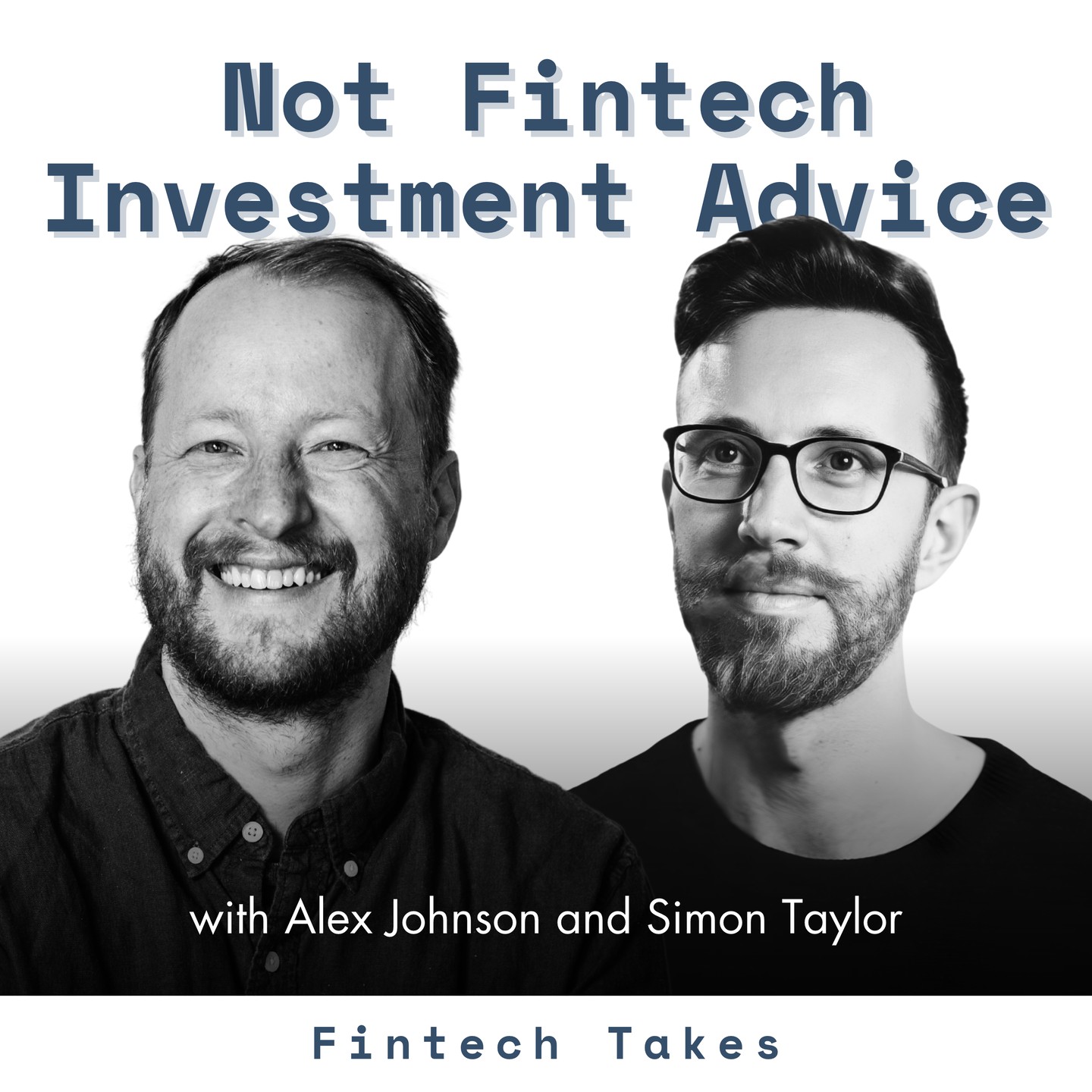
In this week’s episode of Not Fintech Investment Advice, Simon Taylor (creator of Brainfood, formerly Fintech Brainfood) and I did our usual thing. We wandered through a few startups we found interesting, for reasons that remain entirely unrelated to investment advice.
Simon came in hot with a rebrand and a thesis that fintech is dead. (He doesn’t mean it the way it sounds; tune in.)
From there we orbited travel points for savers, guarantees for AI agents, fuel payments without fuel cards, and financial counseling inside addiction recovery.
As usual, we got a little philosophical along the way.
Tune in for the full conversation here
And read below for my three big ideas...
#1: Savings That Brings Sexy BackCopy anchor linkCopied
Symphony has a proposition I wish more financial services companies would focus on: Reward people for putting money aside rather than spending it. Customers can receive rewards in cash, travel points, or a mix, then redeem those points for flights, hotels, and experiences. It's a smart bit of counterpositioning against the mania around points tied to spending. Make savings sexy? I'm in.1
Of course, spending rewards has an obvious economic advantage. Every credit card swipe makes money for everyone downstream, from merchant to issuer to network. They may fight over how to divide it, but there's enough to go around to fund those rewards. Savings, by contrast, doesn't generate revenue by itself. Someone has to do something with the money first.
Symphony does. Looking at its website, I thought it was admirably upfront about its advertised 5% yield, generated through investments like Treasury bills, collateralized loan obligations, private credit, and overcollateralized lending. This isn't an FDIC-insured savings deposit, and I appreciate how clearly Symphony explained where its yield comes from.
Which also sent us down a rabbit hole about where saving ends and investing begins.
Simon argued that traditional savings products are a tough proposition in a world of 3% inflation, but in a world where folks equally need a “rainy day” fund and instant access to cash.
For the customer a notch above just getting to the end of the month, it reminded me of the explosive growth of money market funds in the 1970s. The same thing that’s happening now also happened then: When inflation eats into what people can earn saving one way, alternative products come into the market and offer it a different way. We later saw some of those funds fail, and there were regulatory actions in response.
There's a whole continuum of products with different risk/return tradeoffs, and right now the only two words we have for them are “save” and “invest.” A product that’s responsibly offered and discloses where the yield comes from, can sit somewhere slightly different on the risk versus return curve without being a problem.2 In fact, I’d argue that the impulse to responsibly package savings in new ways is a healthy one.
#2: What Happens When Your Agent’s Better Than Mine?Copy anchor linkCopied
In my early experiments with Instinct and Muse, I've encountered plenty of what I call "weird last mile problems,” where an agent almost completes a task, but can’t seem to go through the final door. This last mile problem doesn’t invalidate the technology, but still: What if the task’s consequential enough that you need assurance that it will get done?
That’s the problem Spoolis, a very early-stage company, is exploring – a kind of guarantee for the outcomes of work delegated to AI agents. The analogy is Coalition in cyber insurance. Coalition provides the software you use, and if you use it, Coalition insures you against cybersecurity incidents, because it understands that software well enough to price the risk. Spoolis wants to bring that model to AI agents.
Simon agreed liability is the first question. Two bank CEOs had asked him whether they should block Muse, and even he couldn’t give an easy no. How do you guarantee a travel booking, he asked, if one website won’t cooperate? I imagine guarantees will have to be pretty specific. Amex, for instance, as both issuer and network, can require agents to register inside its own little sandbox, narrowing the risk it can take on.
That’s a step forward on liability within its agentic commerce framework. It doesn’t generalize to the whole market, because not everyone has Amex’s sandbox.
Simon came at it from a different direction with AIUC, the AI Underwriting Company. Instead of guaranteeing agents one use case at a time, AIUC offers what Simon called “SOC 2 for AI”: A standard covering data and privacy, security, safety, reliability, and accountability, designed to unlock enterprise adoption. That’s low-hanging fruit, he said, because “I don’t have to go use case by use case by use case.”
He doubted insurance was the answer for every workflow, though. Payments runs on a liability model that isn’t insurance. What he wants to see goes something like this: Did the agent reach your ultimate outcome, and if it failed, what are you willing to pay to be made whole?
That got me thinking; performance can depend on the intelligence on the other side. If I show up with a public defender and you hire a lawyer charging $5,000 an hour, I can predict how that goes. Suppose my agent faces Simon’s, and his AI sits 5% higher on the cost-for-performance curve.
Simon asked whether agents from Meta, Google, or Apple would outgun what a community bank can build, and whether they’d extract more from you. His own Instinct filed a refund on a cancelled train trip he never would’ve chased. From his perch, that feels like magic, and from the bank’s seat, that feels like a customer who is, well, kind of “weaponized.”
Maybe Shopify is the thing on the other side that helps small businesses make sure they don’t get ripped off by consumers’ agents, the ones Muse is powering. But whatever unfolds, it’ll be fascinating, and I’ll be staying tuned.
#3: Fuel Payments Without the Fuel CardsCopy anchor linkCopied
A driver pulls up to a gas pump. The app checks the driver’s location and which pump they’re standing next to. If the purchase fits company policy, the fuel unlocks, but otherwise the pump won’t work.
The scene I’ve conjured up is what Piston, a startup that fuels payments for fleets without fuel cards, does for a living. A fleet operator controls which driver fills which vehicle, and said driver pays through the app, in what Simon called a seamless, open banking-like experience.
Simon’s first reaction was the obvious one. Why not just use a fuel card? And doesn’t this only work at pumps that have signed on?
It sure does.
But picture a local delivery contractor, for example. They revisit the same areas and run the same routes, so Piston can recruit stations around their customers, and build a payment network one fleet at a time. Simon understood many of those stations to be franchisees who each have to be sold individually. He and I both wondered about scale, since cards work everywhere and this works only for certain businesses in certain places. But Piston has more than 2,000 stations across 48 states and says 98% customer retention. As Simon put it, “something’s working here for some people.”
It reminds me of the Ramp ethos applied to fuel (Ramp is card-centric, so the analogy only goes so far). Ramp starts from the idea that every dollar needs to be accounted for, and it builds controls around each place money moves. Cards are great at ubiquity, which is also their downside, because an employee can do almost anything with one.
When the U.S. finally rolled out chip cards, gas stations were the last category of merchants that had to upgrade their terminals, because nobody wanted to ask them to rip out everything at the pump and replace it. Pumps have been upgraded since, and I’d guess that’s part of why this is possible now. I don’t know how Piston’s integration works, but I’m quite sure stations could n’t have accommodated it a decade ago.
On Piston’s site, fraud prevention is the first dropdown item under Platform. They know the driver because the driver logs in through the app, so every link in the chain can be verified. With fuel cards, you take a lot on trust. A massive fleet operator or an owner of a bunch of gas stations probably built their own workarounds.
It’s the independent carrier and the franchisee who have to manage this on their own, so that’s where this can grow organically, slowly and in fits and starts, because the network has to be built before anything sits on top of it.
WHAT I'M LISTENING TO
#1: AI Is Smarter Than Ever. So Where’s the Revolution? (Plain English) 🎧Copy anchor linkCopied
Nuanced and informed podcast episodes on AI are so rare. This is one of them.
#2: Congress May Flip. What Actually Changes for Banks? (Banking With Interest) 🎧Copy anchor linkCopied
My guess? Not much.
But I’m not an expert. Rob and his guests are and this episode is really worth a listen!
*Bonus: Collections Conversations (by me, with C&R Software) 🎧Copy anchor linkCopied
What can U.S. fintech learn from lenders across Africa? Quite a lot, actually. In Episode 2, Neré Jansen Van Vuuren explores how to read a missed payment when income follows market days and harvests (vs. a monthly salary). Plus, why a sale isn’t a sale if the money’s not in the bank, and how AI can make collections (ironically) more personal.
*This rec is brought to you by one of our fantastic brand partners.
Thanks for the read! Let me know what you thought by replying back to this email.
— Alex
Footnotes
- As I’ve said and written before, my personal passion project remains making CDs sexy again since they’re an amazing product with awful marketing. ↩︎
- That was my gripe with the early versions of these products that ran on crypto-collateralized lending; they didn’t tell you where the yield came from, and in some cases they lied about it or about how safe it was. ↩︎