Money2026
Happy Friday, Fintech Takers!
Well, that was one long and highly productive week.
I hope the same was true for you. And I hope you spend the next couple days unwinding with some distinctly non-fin and non-tech tasks (cooking is my go-to non-work activity, although raking and winterizing my yard is probably what I should spend my time on).
I have some Money20/20 takeaways for you today. If you were at the show, I’d love for you to hit reply to this email and share your takeaways with me!
- Alex
When Money20/20 was founded in 2011, the organizing question for the event was, “What will money look like in 2020?” Hence the name of the show. As 2020 approached, the organizers shifted the branding of the event to introduce the slash, shifting to a vision-based theme centered around the idea of seeing the past, present, and future of money.
Personally, I wish they had opted to update the name every single year, starting with Money2021. However, as with many things in life, and, especially with Las Vegas-based events, we can’t always get what we want.
DensityCopy anchor linkCopied
My first observation about this year’s event was that the density of participants was, as usual, unmatched. There’s really nothing like trying to wade through the packed hallways of the Venetian — through Restaurant Row, outside the Starbucks, or past The Wizard of Oz sign (RIP the LOVE sign) — and being stopped for a quick handshake or hug by someone you know, at least half a dozen times, and then repeating that experience 20-25 times over the course of four days.
It’s overwhelming and invigorating. Like being inside the fintech equivalent of a nuclear reactor.
However, in keeping with previous years — though definitely greater this year — the density of the event was mostly outside the event itself. The hallways were packed. The restaurants were packed. The casinos and lobbies and random seating areas were packed.
Comparatively speaking, the exhibit hall was not packed. I saw fewer vendor booths and more creatively-filled non-vendor spaces there than ever before. I also saw fewer folks with badges than ever before. In fact, the most well-trafficked area that was technically inside the Money20/20 perimeter was Restaurant Row, where attendees without badges can visit but vendors are required to go through the event to secure spaces (which, as I understand it, has become a large source of revenue for Money20/20).
The reason for this — at least according to all of the attendees and sponsors I personally spoke with — is because Money20/20 has become too expensive. The event charges high prices for attendees (unless you are a banker and you agree to attend a set number of meetings with sponsors) and extremely high prices for sponsors. It even charges a discounted price for tickets for speakers, which is a major diversion from the best practice of giving free tickets to speakers that you see at most events.
Seemingly in response to this trend of companies and individuals choosing to participate in Money20/20 without paying to attend, exhibit, or speak at the actual event — the Lobbycon strategy, as folks call it — Money20/20 is moving from the Venetian to the Las Vegas Convention Center next year. The idea, I guess, is that the event organizers will have a greater degree of control over the participants at that venue, which will allow them to more effectively monetize every content session, sales conversation, and brief hallway handshake that happens.
I asked every single person who I met with at this year’s event what they thought of the move to the Convention Center, and, unsurprisingly, it had a 100% disapproval rating. Some folks understood and even empathized with the frustration that the event organizers feel about the Lobbycon strategy, but none of them — not a single one — thought the move to the Convention Center was a good idea. Not for attendees. Not for sponsors. And not for the event itself.
And there was real confusion about what next year’s event will look like and how individuals and companies will choose to navigate it. How many companies will choose to sponsor and get booths in the exhibit hall, knowing that fewer people may attend? How many folks will choose not to attend or even speak, given the combined cost and inconvenience? How many companies and individuals will choose to go the Lobbycon route? And if they do, which lobby will they choose? The Venetian and Palazzo? The Wynn? Resorts World?
No one knows.
We enter a new world next year. A world that is likely to be less dense and more distributed (like the various Fintech Weeks that already happen in cities like New York, D.C., and Boston). A world that — I worry — will be less valuable for everyone involved.
AI AnxietyCopy anchor linkCopied
Every Money20/20 has a defining emotional theme, and this year’s was anxiety.
Specifically, AI-induced anxiety.
That’s a change. For the last few years the dominant AI-fueled emotion was excitement. AI was coming, it was going to be huge, and every conversation was someone telling you what they were building with it.
This year, things shifted. AI isn’t coming; it’s here. And the question I heard over and over was some version of: Are you ready?
The reason for this shift is, I think, obvious. AI — and agentic AI, specifically — has finally made contact, at scale, with reality. Muse and Dots are here. Instinct and Claude Duet are kinda here. These proactive personal AI assistants are interacting with companies’ systems with their customers’ permission and account credentials.
In response, the big banks have already instituted blocks on all external AI agents. These blocks were motivated by a number of different factors, including very legitimate and understandable concerns about security and liability.1
Not surprising. The more interesting question is how the banks that want to safely open their systems to their customers’ third-party AI agents can actually do it.2 This is, fundamentally, a question of identity and permissioning: Do we know this AI agent and do we know what the customer behind the agent has authorized it to do?
There are lots and lots of companies working on answering these questions. They have developed numerous protocols and frameworks, all of which have similar-sounding names and acronyms. They are open, in the sense that anyone can join as a member or design partner. However, they are also clearly owned and controlled by specific companies with specific commercial interests around use cases like agentic commerce: Visa’s Trusted Agent Protocol, Mastercard’s Verifiable Intent and Agent Pay frameworks, and Meta and Sierra’s new Personal Agent Protocol (which Visa, Mastercard, and Bank of America are all participating in as design partners), to name just a few.
The desire to own and control these protocols and frameworks is understandable, but it’s also self-defeating. To function as true industry standards, they can’t, by definition, also serve as sources of competitive advantage or differentiation. Big banks like JPMorgan Chase aren’t going to get onboard until there is one universal, cross-industry "know-your-agent" standard, paired (in their ideal world) with clear and favorable liability definitions when transactions go wrong.
By contrast, companies that operate closed, end-to-end networks are making more headway in defining and implementing frameworks for things like agentic commerce, because they don’t have to worry about getting other parties onboard. They can just set the rules and require everybody to play by them. American Express appears to be the furthest ahead on this front, with its Agentic Commerce Experiences developer kit and its newly-released Intent Intelligence Framework. However, I would expect to see Capital One (better positioned here thanks to the Discover acquisition) and Stripe (growing quickly in agentic commerce on both the merchant payment acceptance and consumer wallet sides) make some significant leaps forward here as well.
The Long TailCopy anchor linkCopied
I attended a dinner where bankers and fintech executives were asked, “What would you like to see the media do better, when it comes to the discussion around AI?”
One of the most popular answers?
Be more honest and direct about the fact that AI systems still make mistakes … quite often.
So, OK, I will!
AI systems still make mistakes. A lot of mistakes. And while models are continuing to get smarter and we are getting better at engineering systems around those models in order to further reduce the incidence rate of mistakes, we’re still a long way from lowering that rate to an acceptable level.
And, of course, the definition of “acceptable level” varies quite a bit by industry.
In financial services, the places where AI screws up tend to be the exact places that are most expensive to get wrong.
The economics of AI look spectacular right up until you meet the long tail. If a task is 90% routine, a model will handle that 90% smoothly and cheaply, and the demo will be dazzling. It’s the other 10% — the exceptions, the weird edge cases, the “this applicant is in a community property state, recently deceased, and disputing a charge from a merchant that no longer exists” situations — that quietly eats the business case. To handle that 10% safely, you need policies, and manual review queues, and escalation paths, and the kind of institutional knowledge that takes years to accumulate and is painful to encode. Once you’ve paid for all of that, it is not at all obvious that your AI agent is cheaper than the human it was supposed to replace.
This was another point that the folks attending this dinner strongly emphasized. The question should never be, “Can AI do this task?” It should be, “Can AI do this task, including all the ways this task goes sideways, for less than it costs me to have a person do it?”
In a lot of regulated workflows, the honest answer is still no.
For fintech infrastructure companies, this is good news. If the thing standing between a model and real deployment is a deep understanding of the long tail — where it hides, what it costs, what to do when you hit it — then the value doesn’t accrue to whoever has the best model. It accrues to whoever understands the exceptions. The labs supply the models. You supply the harness. And the harness, built on years of knowing exactly how your corner of finance breaks, is the thing that’s difficult to replicate.
An Issue of TranslationCopy anchor linkCopied
It has been becoming clear to me for a while — and my conversations at the conference solidified it for me — that transformer-based credit risk models are inevitable.
Most big lenders are testing them. However, the only lender that is running them in production — so far as I know — is Affirm. And the model Affirm put into production in September isn’t a transformer making credit decisions. It’s a two-stage hybrid. A transformer reads the credit report and learns richer representations of it than traditional models would. And then those representations are handed to a second-stage gradient-boosted machine learning model, and that’s the thing that actually makes the decisions.
Plaid’s newest credit risk model — LendScore Arc — is also a transformer-based credit risk model, built on top of Plaid’s sequential foundation model. It is designed to be run in production and the early-testing results reported by Plaid are compelling (20% predictive lift over Plaid’s core model on deep-subprime borrowers, 24% on super-prime). However, it’s important to note that Plaid isn’t a lender and it’s not yet allowing its customers to run LendScore Arc in production. It’s currently in beta and can only be used for evaluation purposes.
That gap — between how good these models are and how willing anyone is to actually let one make a credit decision — is the thing to pay attention to. Because it isn’t a performance problem. Everyone agrees the reasoning is better. It’s an explainability problem.
Linear regression is the simplest analytic technique used in credit decisioning. It’s been around for decades. And the decisions made with it are easy to explain. Each input into the model gets a weight and the score is the weighted sum of the inputs. To explain the score, you simply read the weights back out: This input, times its weight, moved the score this much.
Gradient-boosted machine learning models are the vastly more complex and capable cousins of linear regression models. Until recently, they have been the cutting-edge in credit risk decisioning. However, the crucial thing to understand is that the way we explain their outputs — using methods like SHAP — is fundamentally the same approach we take to explaining the outputs of linear regression models because both types of modeling are doing the same basic kind of thinking: Building an answer out of weighted, additive contributions from the inputs. To explain a model like this you have to decompose the final score back into per-input contributions, in the units of the inputs themselves.
The models reason in the vocabulary of their inputs, so explanations phrased in the vocabulary of their inputs genuinely describe them.
Transformers don’t reason that way. The first thing a transformer does is let every input reinterpret every other input. Income gets read in light of employment history, which gets read in light of address stability, with each value’s meaning bending based on the full context around it. Then it stacks that process, layer on top of layer, building internal features that are blends of blends: Combinations that don’t correspond to any single input and that exist only inside the model. The decision gets made over those.
To explain the decision, you can still run a SHAP-style method and get a per-input number out the other end, but that number is now a translation, not a description. You’re taking a decision that happened in the model’s invented internal vocabulary and projecting it back down onto the original inputs. It’s still directionally helpful, but it doesn’t actually explain how the model is thinking.
It reminds me of the movie Arrival, in which a linguist (played by Amy Adams) tries to communicate with aliens who experience time itself differently than humans do. She is partially successful at decoding the simple visual symbols that the aliens share, but she can never fully understand what the aliens mean, because the cognition behind the symbols isn’t shaped like hers. The best she can do is translate it into a form her mind can hold, and the translation is never the thing itself.

In the movie [spoiler alert!], humans save themselves from self-destruction when they learn to actually understand the aliens’ language, rather than merely translating it, and that understanding fundamentally alters their perceptions.
It’s unclear to me when (if ever) financial services regulators will come to understand how transformers actually think and how that understanding will alter their perceptions of fairness and accountability (which are the principles that underpin the legal requirement to explain adverse consumer credit decisions). However, it is clear that lenders, for the moment, do not feel comfortable even attempting to translate transformers’ decisions into the language that regulators already understand.
TomoCredit is Still Doing ThingsCopy anchor linkCopied
Apparently TomoCredit is still around and doing things. They launched a new AI capability at Money20/20 called Money Finder, which is a part of its TomoIQ financial assistant, designed to “help consumers lower everyday expenses, explore financial products, and find resources relevant to their circumstances.”
Kristy Kim, Founder and CEO of TomoCredit, was quoted in the release, saying:
The next generation of consumer AI won’t just answer questions. It will help people take action … For a single mother trying to lower her bills, a gig worker looking for a credit card, or an immigrant navigating the U.S. financial system for the first time, the value of AI is practical: What can it help me do? That’s the question we’re building Money Finder to answer.
Sounds great. Everything this company says that it does sounds great. And noble. Helping single mothers and gig workers and immigrants with the power of AI. A+ messaging.
However, in terms of actually delivering on those value propositions, the grades from actual customers are … not good.
TomoCredit currently has an F letter grade (for having 758 complaints filed against it and a failure to respond to 605 complaints) and a 2.12-star customer-review average (out of 5) on Better Business Bureau. On Trustpilot, TomoBoost (the company’s credit-building service) has 113 customer reviews, with an average 1.8-star review (out of 5). For TomoCredit, you actually can’t see the company’s average customer rating because Trustpilot detected and removed a number of fake reviews, which is a violation of Trustpilot’s guidelines.
Here’s one recent review from a user who verified their identity on Trustpilot:
I signed up for TomoCredit with the understanding that they would report a credit line to the major credit bureaus to help build my credit history. Instead, TomoCredit charged me a monthly fee of $129 for 5 to 6 consecutive months. During this entire time, they failed to report any credit line or activity to the credit bureaus. I paid hundreds of dollars for a service that was never delivered, essentially paying for absolutely nothing.
When I disputed the fees, I was explicitly assured by TomoCredit representatives that my monthly charge would be lowered to $39. This modification never occurred, and the company continued to extract the $129 monthly fee from my account without authorization or delivery of service.
I have made repeated, exhaustive attempts to cancel this service, but every time I emailed customer support requesting immediate cancellation, they refused to process it and instead sent evasive follow-up questions to delay the process. Additionally, I scheduled two separate video consultation appointments for this purpose. On both occasions, no representative from TomoCredit showed up to the call.
So I'm out of hundreds of dollars and nothing to show for it and they have not taken any accountability.
In its response to the user, TomoCredit encouraged them to “explore TomoIQ, our AI-powered financial assistant, which analyzes your credit report, explains factors affecting your score, and provides personalized financial guidance.”
You can’t make this stuff up.
Infrastructural EntrenchmentCopy anchor linkCopied
There was a feeling at the show — I heard versions of it in several conversations — that the financial industry has a window right now to change the facts on the ground in ways that will be beneficial to the industry.
There are two ways to do this and they are not equally durable.
The first is regulatory: Issue guidance, get a rule on the books, put out a public statement to nudge the industry in the direction you want it to go. The problem is that this form of entrenchment is fragile.3 As the current administration has emphatically demonstrated, guidance can be rescinded, rules can be rewritten, and politically-motivated public nudges can change direction dramatically. Plus, you know, administrative law is an absolute mess right now. A lot less deference paid to regulators and a lot more lawsuits. Fun!
The second way to do this is infrastructure. Once the plumbing exists — once there are thousands of live connections, integrations, and workflows that real people and real businesses depend on — reversing the policy means breaking things that are in use. That has a cost that even a hostile regulator flinches at. A rule can be struck down, but an infrastructure dependency can’t be un-built nearly as fast.
The smart policy people working at banks and fintech companies aren’t allowing themselves to be drawn into loud and contentious public fights over rulemaking that can and likely will be changed under the next administration. Instead, they are quietly trying to operationalize reasonable best practices for how they think their parts of the industry should work and betting that — if those best practices become common and hardened into infrastructure — they will be practically impossible to rip out.
The most tangible example of this right now is the move to make consumer permissioning for cash flow underwriting more expansive, in order to make the consumer experience more convenient and easier to put in more prominent positions in digital lending workflows. Plaid and Nova Credit are leading the charge here.
The Perception Advantages of Being a BankCopy anchor linkCopied
Most of the arguments for getting a bank charter are mechanical — funding costs, interchange, control of your own rails — but two of the advantages I heard discussed at the conference this year aren’t mechanical at all. They’re about perception.
The first is what the word “bank” does for customers. It conveys trust. People are reassured by it in a way that, believe it or not, lowers the cost of acquisition. When you can legally call yourself a bank, you spend less convincing people to hand you their money. That reassurance is a real asset, even though it never shows up as a line item on the balance sheet.
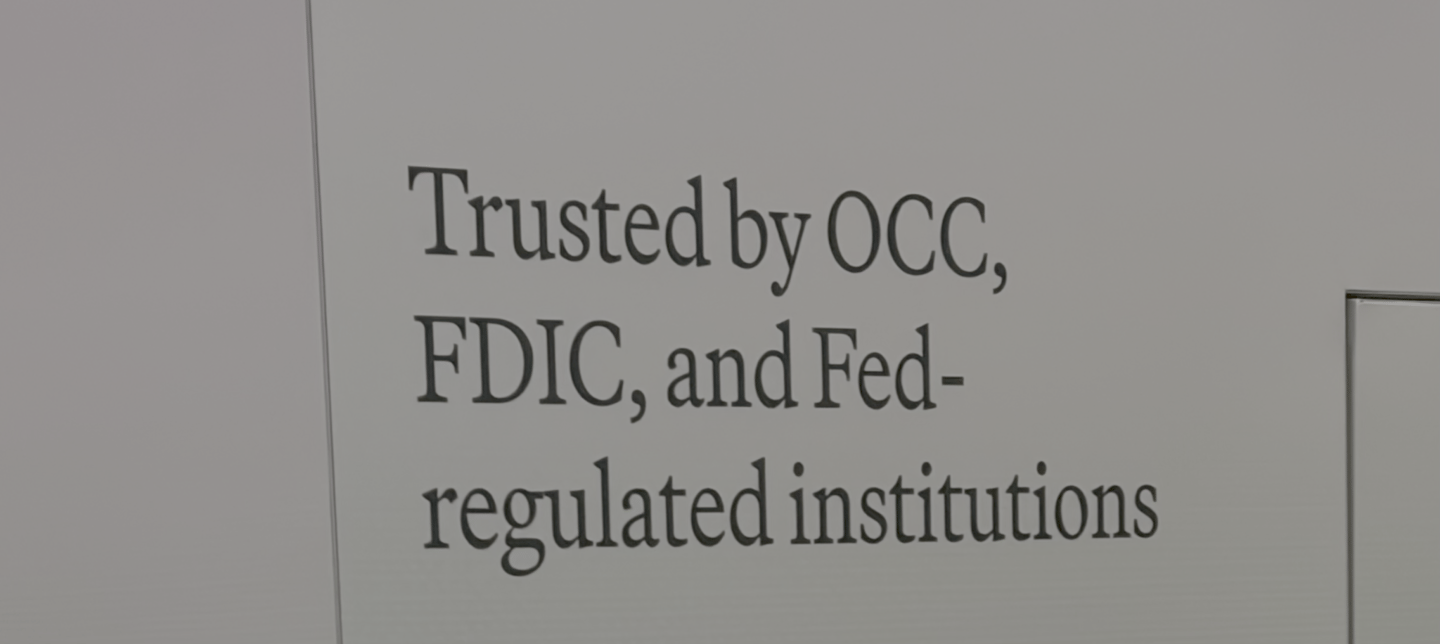
The second is what the word “bank” does for investors. There’s a growing conviction among investors that it’s better to be a balance-sheet business than a SaaS business, because a balance-sheet business is harder for AI to disrupt. Whether or not that’s durably true, it’s increasingly being priced in, and it makes a charter look less like a regulatory burden and more like a moat.
Stablecoins vs. Tokenized DepositsCopy anchor linkCopied
The most interesting infrastructure argument at the show wasn’t stablecoins versus banks. It was stablecoins versus tokenized deposits.

In my head, I visualize the ideal uses of stablecoins and tokenized deposits as sitting on a continuum. On one end of the continuum are use cases that require openness and interoperability (think consumer cross-border remittances). These are where stablecoins shine. On the other end of the spectrum are use cases that don’t require significant openness or interoperability, which are the use cases where tokenized deposits’ other advantages (like the ability to pay yield or to keep transactions off publicly-visible blockchains) tip the balance in their favor (treasury management for international corporations would be a good example).
We are seeing traction on both sides of the continuum, but what was most apparent to me after talking to folks in Las Vegas this week is that stablecoins and tokenized deposits are both trying to move towards the middle.
Tokenized deposits are becoming more interoperable; JPMorgan is bringing Kinexys onto public blockchains post-GENIUS (it announced Ethereum this week), and the big banks are working toward a shared tokenized-deposit network. Stablecoins, meanwhile, are becoming more payment-like and more bank-adjacent, with issuers and network operators adding things like privacy zones (Tempo just went live with its privacy solution with its first customer, Deel, last week). Everyone is trying to grab as much of the continuum as they can, and my sense is that tokenized deposits can claw back quite a bit of ground from stablecoins’ lead if they can solve interoperability.
This will be more important for small banks than it will be for the biggest banks. For JPMorgan, a tokenized deposit works inside JPMorgan — it’s a closed system within one enormous bank, and it needs exactly no one’s cooperation to be useful (Though JPM and the other big banks are moving towards greater interoperability anyway). For smaller banks, a tokenized deposit is only worth anything if it can move across institutions, which means it’s useless without a shared network and a common standard. So tokenized deposits are a cooperation-dependent product for everyone except the handful of banks big enough to be their own network.
WHERE I'LL BECopy anchor linkCopied
OK, I am a bit tired. But the fun continues soon!
✈️ AFC Policy Summit | November 17 | Washington D.C.Copy anchor linkCopied
One of the best possible places to go if you’re looking for dense and nerdy finreg conversations. Plus, somehow Phil Goldfeder manages to hi five or shake hands with every single person.
✈️ Fintech NerdCon | November 18-20 | San DiegoCopy anchor linkCopied
I’ll be flying from D.C. to San Diego (arrghhhh), but it’s worth it for year two of NerdCon! Plus, San Diego rules.
Thanks for the read! Let me know what you thought by replying back to this email.
— Alex
Footnotes
- Axios had an interesting story on banks’ perceptions of how AI agents are already impacting their systems. It’s not nearly as shocking or scary as the headline and the Twitter discourse around it make it seem. ↩︎
- It’s a small list right now. Most banks profit off of inertia and are not interested in inviting in third-party AI agents to eliminate that inertia and disrupt their profitability. ↩︎
- Obviously, an exception to this is the passage of new laws, like the GENIUS Act. Equally obvious is the fact that the passage of these new laws is very rare, which makes them the exception that proves the rule. ↩︎