The Worry Budget
Highlights from the Fintech Takes Podcast
Happy Wednesday, Fintech Listeners!
Another AFC Policy Summit is in the books! My thanks, as always, to Phil and the entire AFC team for their hospitality and organizational vigor, as well as to the folks at Spencer Fane for a wonderful dinner with old and new fintech friends.
It was great to get to meet many of you in person for the first time, and to reconnect with folks I hadn’t seen for a while.
Now onto San Diego and Fintech NerdCon!
— Alex
3 BIG IDEAS FROM THE PODCAST
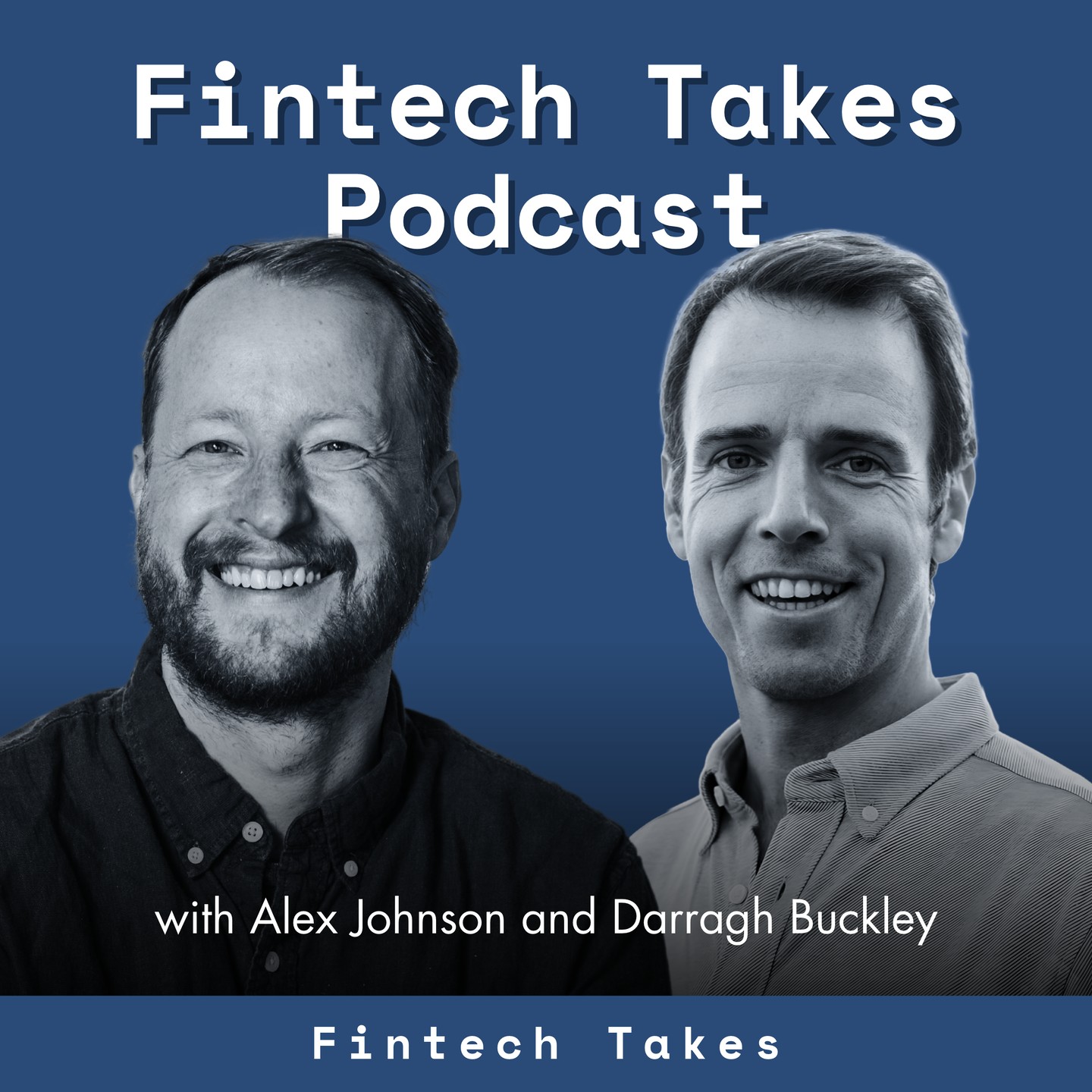
Darragh Buckley, founder and CEO of Increase, has been on the Fintech Takes podcast before, but never one on one. Which meant in today’s episode, I could finally ask Stripe’s very first employee all the questions I’ve saved up. Yay!
We chatted about lessons Darragh took from the early days at Stripe and the wonderfully nerdy world of banking infrastructure, then closed with a timed lightning round on agentic AI (and what it still can’t take off your plate). We also dug into what happens when engineers pick your banking infrastructure, and why Increase now owns a bank.
Darragh is super fun to talk to. He lives in the weeds, and I learned a lot from our conversation (and I know you will, too).
Tune in for the full conversation here
And read below for my three big ideas...
#1: You Can’t Outsource the Worry Budget (Yet)Copy anchor linkCopied
I benefited from a hiring model that AI may be changing.
As a 16-year-old intern, I wasted so much of other people's time and productivity on projects with a negative ROI for the business. Today, basically any unit of intelligence out there starts at a higher competency level than 16-year-old Alex.
So I asked Darragh how he thinks about staffing at Increase, which has been conservative with headcount from the start.
These days, AI can already work through tickets in an engineering backlog or produce collateral for sales meetings. What Darragh doesn't feel comfortable outsourcing comes down to a concept he calls the "worry budget."
When it comes to bookkeeping, he wants a person to have a sense of whether the numbers look reasonable. Likewise, taking notes in sales meetings is one thing; making sure they fit together sensibly is another.
That resonated with me. One example: The best events marketers I've worked with are a perfectly-blended combination of hypercompetent and hyperparanoid. When you hand them something, you can trust they've worried about things you haven't even thought of. AI, by comparison, has no intrinsic urgency. It'll move as fast as you push it to.1
Darragh wondered whether that means purposely introducing anxiety to robots, and joked whether they could get joy and happiness first. His real benchmark is a feeling he’s had at Stripe and at Increase. You walk into a meeting, see who’s there, and realize your presence adds nothing. You got it? Cool. I’m out.
He’s not yet had that experience with AI (and neither have I).
And that’s the open question for banks and tech companies deploying AI agents: Can an agent reliably carry responsibility for an outcome, beyond doing the work? Until one can, the worry stays with a human.
#2: The Details Are the ProductCopy anchor linkCopied
Here’s what looks like a contradiction in Darragh’s career. He was the first employee at Stripe, a company that created a beautiful abstraction over payments: You’re a developer, you want a /payments API, and Stripe handles all of the complexity. Then he founded Increase, whose API design principle is called “No Abstractions”.
The contradiction dissolves when you look at the customer. Darragh is quick to say the principle isn’t meant to be universal; it has held true for Increase and its users. Their users are engineers at companies like Ramp or Gusto who compose banking inside their own products. They don’t want the details hidden. They want the full capabilities and data of the underlying network.
“If it’s called company entry description at FedACH, I want the parameter to be called company entry description.” The goal is an integration that’s utterly unsurprising.
Those engineers are increasingly the ones choosing the infrastructure, too. Around 2010, engineers obviously chose between AWS and Google Cloud. The choice between Chase Paymentech and Wells Fargo Merchant Services, though, surely belonged to finance. Stripe changed this dynamic. It made getting started so quick and easy that the engineer evaluating the APIs made the call. Procurement only caught up weeks later, asking who exactly the company was using for payments.
That’s powerful. It’s also potentially dangerous, because engineers might not understand all of the choices they are making when they make them.
Darragh’s example: Your code would be simpler without the data elements required on wire transfers above $3,000, but don’t remove them without talking to your friendly compliance department. First-principles thinking, if naively applied, can be dismissive of experience. Some rules you can’t derive. You just know that if you say this thing to the regulator, “They are immediately going to say, that’s nice, get out now.”
Exposing the details is half the job. The other half is respecting the experience behind them. The challenge is recognizing when the underlying details, and the expertise required to navigate them, are precisely what your customers need.
#3: Give the Agent $100 and Let It LooseCopy anchor linkCopied
Darragh thinks banks could make AI agents more useful by letting consumers provision separate payment instruments, from cards to entire bank accounts, and grant their agents some "economic agency."
I've already given an AI agent a payment card, though not my everyday one.
Darragh said he’d rather give an agent $100 in an isolated account than introduce more controls and approvals that demand his attention. Sure, in his example it might accidentally order 50 apples, but its spending is bounded.
The rub? Darragh says only about half a dozen banks in the country let ordinary customers provision accounts and sub-accounts this way.
Which brings us to his prediction about agentic commerce.
Banking conversations often focus on increasing consumer trust enough to drive adoption. Darragh suspects adoption will have very little to do with increasing trust. Instead, he predicts that convenience will drive adoption, even if consumers’ trust in AI agents doesn’t increase.2
And he sees a particularly hopeful application of that convenience for small, community-focused businesses. Darragh would prefer to buy coffee beans from a local roaster and books from his neighborhood bookstore. But when he's short on time, he defaults to Amazon. His stated and revealed preferences don't match. Agents could help reconcile the two.
I offered a more ridiculous example of what agentic AI could make possible. Say I'm looking for a 36-inch felling axe, forged by one of two particular Swedish blacksmiths, with a specific handle (I live in Montana after all, in case you missed it). I’ll type out what I’m looking for, in exacting detail. What I get back is the most generic possible sorting of that, Oh, you want an axe!
No! I want the one made by one of the only forges that meets my requirements, even if it produces a couple hundred of the damn things a year!
I'm happy to get in line. What excites me about agentic AI is the possibility of describing exactly what I want and then having an AI agent translate those preferences into a search that finds the exact felling axe of my wood-chopping dreams.
And that's an intriguing possibility for small merchants. AI agents could make it easier for customers to find the particular things they value, even when the seller is too small or obscure to surface in conventional search. Maybe they could help consumers make purchases that better reflect what they actually want, without convenience always deciding that Amazon wins the business.3
WHAT I'M LISTENING TO
#1: Agent of Record: Agentic AI and the End of Customer Friction (Bank Nerd Corner) 🎧Copy anchor linkCopied
Look at the collection of people who are in this episode and you’ll see why it earns an automatic recommendation from me!
#2: Who Killed the Internet's Business Model? (Plain English) 🎧Copy anchor linkCopied
The answer, from my POV, is Google. They proactively killed their own golden goose before anyone else could. Is it possible for someone to take The Innovator’s Dilemma too seriously?
Anyway, this is a good episode.
*Bonus: Cash Flow Conversations (by me, with Nova Credit) 🎧Copy anchor linkCopied
Our series on bringing cash flow data into mainstream lending ends at the dealership. In Episode 8, The Car Lot Meets Cash Flow, Andy Mayers (Lender Solutions Strategist at Dealertrack) explores why fraudulent pay stubs are pushing auto lenders toward permissioned bank data, and why shoppers may one day connect their bank accounts before they reach the lot. Catch the series finale here!
*This rec is brought to you by one of our fantastic brand partners.
Thanks for the read! Let me know what you thought by replying back to this email.
— Alex
Footnotes
- Sometimes it’ll worry less than you instruct it to because it’s subtly trying to optimize its own costs and/or latency, which I find annoying as hell. “I told you to not take any shortcuts. What the fuck are you doing?” is a thing I’ve thought about telling my various AI assistants multiple times. I never do because I don’t want there to be a record of me being rude to an AI in case the doomers are correct. It’s like my own version of Pascal’s Wager. ↩︎
- History is on his side on this prediction. Convenience almost always tends to win, over the long term. ↩︎
- This is essentially Shopify’s bet when it comes to agentic commerce. That AI will supercharge its “arming the rebels” strategy. ↩︎