Fintech Nerd Week
Emptying the proverbial notebook.

Happy Friday, Fintech Takers!
What a week! The AFC Policy Summit (and lots of juicy Washington, D.C. gossip). Fintech NerdCon (and some sunshine and good vibes). An alarming number of outages that may or may not be related to AI (including the United one on Monday, which I got caught in the middle of).
And now I’m on my way home, where there is snow on the ground and the Montana State University football team is about to host the University of Montana football team for a game that is, objectively, the most important sporting event of the year.1
A lot is going on (and we’ve published quite a bit of content this week), so I’ll keep it simple today. Just a few takeaways from Fintech Nerd Week™.2
Sorry it’s hitting your inboxes late. It was a very busy five days!
- Alex
P.S. — I have a couple of awesome folks who are earlier in their fintech careers and are looking for new roles in marketing (content marketing, specifically), business development, and client success. If you’re hiring in these areas, let me know and I’ll make some introductions!
P.P.S. — I am hosting a virtual event — Stablecoins in 2026: A Year in Review — on December 15th. It features a bunch of the smartest and most plugged-in people I know in the stablecoin space. We’re going to talk about what happened this year (spoiler: Quite a bit of stuff!) Join us!
P.P.P.S. — A lot of folks seemingly make the trip from the AFC Policy Summit to Fintech NerdCon. Next year, should we charter a flight (the "NerdBird")? Would it actually be more affordable? Just more fun? Can we get it sponsored? Should this idea become a real thing?!?
Fintech Nerd WeekCopy anchor linkCopied
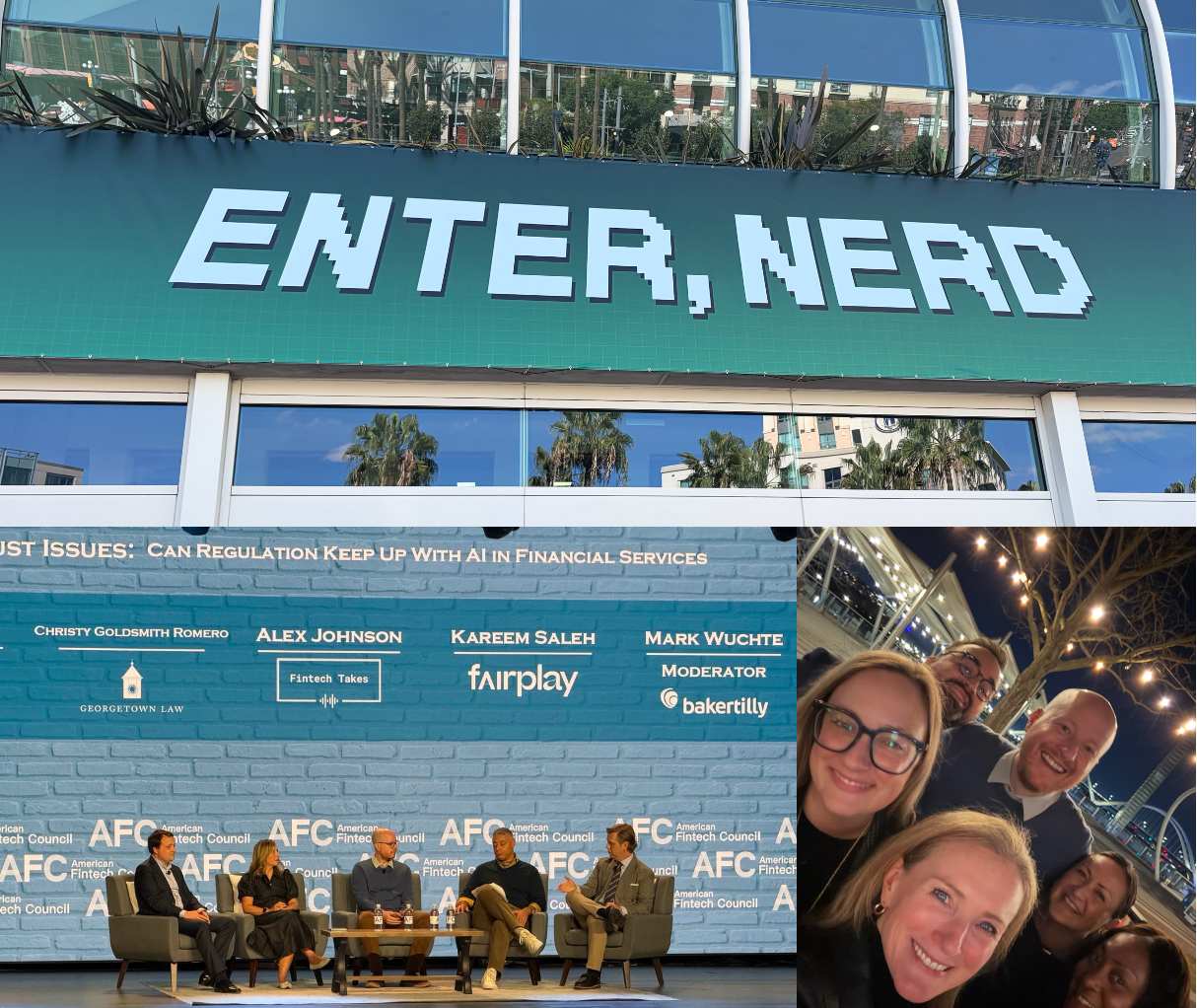
I’m going to skip the preamble this time and just get right to the bullet points:
- Agent Takeover Fraud. Tyler Allen (CEO of Unit21) made a great point at the AFC Policy Summit. We pour enormous effort into the front end of the customer lifecycle (onboarding, KYC), and now we're porting that playbook to AI agents with KYA ("know your agent"). Great. But brand-new agents aren't very risky, because customers don’t trust them with much yet. The danger comes later. The more an agent works, the more delegated authority and bigger budgets it earns, and the bigger the bust-out potential gets. That's the ongoing fraud/risk monitoring part of the lifecycle, and almost nobody is talking about it for AI agents. There's plenty of room for risk to creep in: Agent drift, new models that get swapped in and quietly change an agent's behavior, or outright agent takeover by bad guys. Long term, agent monitoring may matter more than agent onboarding.
- What actually happened at Chase? On Monday, Chase's online banking was disrupted for roughly eight and a half hours, and the delays rippled out to customers at BofA, Wells, U.S. Bank and others on any transaction where Chase was on the other side. Chase blamed a software bug in on-premise hardware, and the FBI said it traced to a software release, not malicious activity. When Comptroller Gould was asked about it at the AFC Policy Summit, he called it "an isolated incident" and not much else, which felt a little evasive. It landed in a week that also saw the Microsoft and FAA outages, which officials are now loosely blaming on a rush of software patching. And a few days later JPMorgan disclosed that some of its vendors were hit by a cyberattack (a separate incident). The OCC is reportedly planning a deeper look. I'd like to see what it finds.
- The biggest obstacle to getting a bank charter is ego. Regulators care A LOT about who will run the proposed bank. Have they run a bank before? Not a fintech company, not an ILC. A federally regulated bank. The OCC in particular is a bit elitist about this. It wants relevant experience and doesn't care how cool you are or what you built outside banking. In fact, if you succeeded by moving fast and taking lots of risks (a point of pride in Silicon Valley), it will make you look worse. This isn't hypothetical: The OCC's first two published charter denials this year (Wise and bunq) both turned heavily on management experience. The trick (according to the experts) is to park your ego at the door, recruit people with deep banking experience, and avoid dual roles if you can.
- The federal bank regulatory agencies aren’t letting debanking go. The OCC told the industry that politicized debanking bears on the factors it weighs in licensing decisions (and I’ve heard that the other agencies are asking about it when they review applications as well), and it just wrapped a debanking review of the nine largest national banks it supervises. My theory: Debanking has to be the first (and maybe only) thing President Trump asks the bank regulatory agency heads about when he meets with them. He claims that he was debanked, and it seems to be the banking issue he cares about most. There’s no other explanation for why the agencies won’t stop talking about it and asking about it.
- Non-prescriptive is the name of the game. In his comments at the AFC Policy Summit, Gould repeatedly articulated the theory that the best way to balance safety and soundness with innovation and competition is to narrow the agency’s focus to risk-tailored supervision of material risks and to be as non-prescriptive and unopinionated as possible about everything else. You can see this in the OCC’s new AI framework for bank examiners, which says AI is not a separate risk category and banks don't need a separate risk appetite for it. Gould also said essentially the same thing about third-party risk management (TPRM) in his comments. He doesn’t want to tell banks how to do their jobs.3 That's a very different theory from the one Biden-era regulators had.
- "Open for business" = Doing the Job. In his comments, Gould also defined being "open for business" on de novo bank charters as simply doing what the OCC should have been doing all along. He said he was embarrassed by the rate of de novo formation after the Great Recession (from 2011 through 2024, the OCC averaged fewer than four charter applications a year).4
- Direct supervision of third parties. When Gould was asked about TPRM, he said that the OCC has "extensive" authority under existing rules and laws like the Bank Service Company Act (BSCA) to directly supervise companies that provide services to banks, and that this is a much better approach than trying to influence them indirectly through the banks. I’m not sure that his perception of the BSCA’s scope of authority is correct (or at least undisputed), but I applaud the sentiment. I wonder if there’s any chance we could see the frontier AI labs come under direct supervision (in a similar fashion to how the public cloud providers are).
- Mike Flood is refreshingly normal. Rep. Mike Flood (R-Neb.) spoke at the AFC Policy Summit and I found him charmingly plain-spoken and normal. He's still fairly new to Congress, which likely explains it.5 Flood argued that Congress should pass laws like the Clarity Act because if it doesn't, regulators will "delight" in writing rules under their existing authority that this new Congress likely won't approve of. He thinks there's an opening to pass a modified Clarity Act with stronger ethics language.6 I don’t think this will happen, but it would be a fascinating counter-cyclical bet for moderate Senate Democrats to make: Bring Clarity back, with everything they want, and dare President Trump and Brian Armstrong to sink it.
- Oversight vs. Lawmaking. Flood also said Democrats will have to choose how many eggs to put in the oversight basket versus the lawmaking basket, because the two are in tension. The more oversight they do, the worse President Trump's mood gets, and the harder it is to pass new laws. He sees fraud and scams as one area where banks, fintech companies, Democrats, and Republicans can come together.
- The CFPB will survive, somewhere in the middle. Flood predicts the CFPB comes back with more funding, but it won't be what Elizabeth Warren wants or what Russ Vought wants. It will be somewhere in between.7 There was optimism from the folks I spoke with in D.C. that Brian Johnson, who cleared Senate Banking 13–11 in September, will be confirmed as CFPB Director in the lame duck session. There was a severe lack of optimism that any Trump appointees get through the new Senate, so they'll have to get jammed through now.
- The memo that is freaking everyone out. There's a 181-page memo circulating in D.C., drafted by the progressive think tank Groundwork Collaborative, which is closely associated with Senator Warren. It lays out a very aggressive corporate oversight agenda for the new Democratic majorities. It has everyone in policy circles freaking out (great for lobbyists!) I got my hands on a copy. Banks are mostly absent. The financial services targets are payments, fintech and crypto:
- Card networks as data companies. The memo proposes a hearing on how Visa and Mastercard data products (Mastercard's Dynamic Yield, Visa's Data Tokens) could enable "surveillance pricing," plus letters asking Visa, Mastercard, Amex and Discover whether they supply data for individualized pricing. This is a new front for the networks, separate from the interchange wars they have been fighting forever.
- Agentic commerce. The memo proposes a full investigation into AI shopping agents (Meta's Muse, OpenAI's Dots, Gemini, Amazon's Alexa for Shopping, Walmart's Sparky): What data they collect, how they rank and steer, and how sponsored prompts work. The memo cites research showing LLMs recommending payday loans and flags "buy-side rogue agents" taking unauthorized actions.
- AI customer service. The memo builds on the CFPB's "doom loop" findings about bank chatbots and names Klarna and Block as targets. Klarna's public claims about AI replacing agents, and its later partial walk-back, are quoted back at it.
- President Trump and crypto. World Liberty Financial is on the list of "politically corrupt" targets (Binance ties, the CZ pardon, DOJ disbanding its crypto enforcement team), and Coinbase CEO Brian Armstrong is a proposed witness about White House ballroom donations.
- Consumer reports and lending. The memo discusses tenant-screening scores (SafeRent, RentGrow, TransUnion) and FCRA claims against AI hiring tools. It also recommends pushing to find out why the CFPB dropped its case against Clayton Homes' lender, Vanderbilt Mortgage, with prejudice.
- The real constraint may be DOJ lawyers. Over the next two years, the binding constraint on regulators may be DOJ lawyers. A lot have left. The Federal Programs Branch, which defends agency policies in court, shrank from 113 attorneys to 71 early in this term, and more than 10,000 government lawyers have left since 2025. The ones who remain will be swamped by Democratic oversight (assuming that Democrats choose to put a lot of their eggs in that basket, which I expect they will). That's ironic when combined with Loper Bright and Corner Post. Administrative law is in a fragile place right now.
- Remember: Shopping is often fun. Max Levchin, CEO of Affirm, spoke at the AFC Policy Summit and in his remarks he provided a good reminder: Some parts of e-commerce are fun and some are a slog. In his view, AI Agents should remove the drudgery without getting in the way of the fun. He said a lot of the engineers building agentic commerce in Silicon Valley don't understand this.8
- The Should/Will Dial. Every product, pricing model and customer service operation has a bunch of options built in for what customers could do. The assumption behind them is that you will get credit for offering them and satisfy the few power users who demand them, without paying the cost of every customer doing so (even though it would be in all of their interests’ to do so). AI agents will push the dial all the way from “should do” to "will do." By default, everyone will take maximal advantage of every option they're offered. That will break a lot of assumptions and business models in financial services.
- NPS-ify Everything. Coding and math are where AI is making the most tangible progress. This week an Anthropic mathematician claimed, working with Claude, a proof of the Riemann Hypothesis, though it hasn't been independently verified yet. The reason is that both fields are measurable. We know what "good" looks like. In fields where "good" is inherently subjective, AI will have a harder time fully disrupting things (I'm hoping writing is one of them). But there are lots of fields and workflows where we could define "good" more rigorously and just haven't, because there was no value in doing so. That's where AI can make a lot of progress. Interestingly, customer service is further ahead, because every interaction has a specific intent (what is the customer trying to do, and did it happen?) and we've heavily instrumented the subjective part with NPS surveys. Agentic AI will make much more progress as we redefine jobs and workflows around measurable evaluations of "good." We basically need the NPS-ification of everything measurable that humans do.
- Escheatment is coming for crypto. I moderated a panel on this topic at Fintech NerdCon with Allen Osgood (Eisen) and Katherine Bacolas (Coinbase) and it was fascinating.9 Quick primer: Escheatment is the process by which states take custody of "abandoned" property, such as dormant bank accounts, uncashed checks or forgotten securities. After a dormancy period (usually around three years with no owner contact), the company holding the asset must report it and turn it over to the state, which holds it until the owner claims it (and, in many cases, makes money on the interest earned while holding it). In California, unclaimed financial assets go to the State Controller after three years. California is one of the most prominent states to put digital assets under its unclaimed property law (SB 822, effective January 2026). That raises lots of interesting questions. Most states liquidate what they claim, which makes it easy to earn interest on it, but that's a problem for assets that appreciate a lot. California takes crypto in kind, which is great for owners, but only for a while: The Controller may convert it to cash 18 to 20 months after it's reported. So how does California make money on it in the meantime? A 2026 bill (AB 2335) would have the state convert unclaimed crypto into a "Digital Asset Reserve Fund" of large-cap assets, and committee amendments would let the state stake them. Not quite crypto lending, but close. Kind of wild.10
- How do we make the "soft" benefits legible to AI agents? How do we compress the soft benefits different providers offer into something AI agents can understand and use in comparisons? If we don't figure this out, only the biggest companies will win, because they win on what AI agents already easily understand: Price, availability, and speed of fulfillment. Shopify has to be working on this. It's the only way its merchants beat Amazon and Walmart in agentic commerce. You can see early versions in its Universal Commerce Protocol (co-developed with Google) and in tools like Knowledge Base that let merchants control what agents say about their brand. Financial services will need its own equivalent, or everyone except Chase will lose.
- The Levels of Worry. Maybe the way to think about personal AI assistants is by the levels of worry they can take off your shoulders:
- Level One: "Did it understand me, and can it do the thing?" The fix is a capable AI agent with a high success rate.
- Level Two: "What happens if it acts and screws up?" The fix is near-perfect performance (unlikely) or robust liability protection (more likely).
- Level Three: "I'm worried about something and don't have a solution." The fix is an AI agent that helps you come up with the solution and carries it out.
- Level Four: "Catch it before I even know to worry." The fix is a proactive AI agent with enough context on your life, enough trust that you delegate to it, and the ability to act reliably. Navan has a cool (narrow) example of level four. If your flight is delayed and you'll get to the hotel after midnight, its AI voice agent calls the hotel to hold the room so the reservation isn't canceled. Then it tells you, and lets you listen to a recording of the call, just to cement that trust. Neat! Imagine if every possible problem in your life got intercepted that way, before it turned into a worry.
- Year 2. The second year of Fintech NerdCon was fun to experience. I attended in year 1, and I would describe the difference almost as the difference between a pre-seed startup and a startup that just raised a healthy seed round. More professional. More buttoned up on the logistics (the sound quality at the stages was MUCH better). But it’s still an early-stage startup and there was a feeling among the folks I spoke with that the event hadn’t quite settled into what it’s eventually going to be. Is it an event for networking and business development? Is it an event that revolves entirely around the content? (Difficult to do, long term, if you rely heavily on sponsorship dollars) Is it just a fun place for fintech nerds of every stripe to hang out? At the moment, it’s a bit of all of these, while not definitively being any of them. That’s perfectly fine, but I’ll be keenly watching how the event evolves from here!
- D.C. vs. SD. Washington, D.C. and San Diego are two of my favorite places to visit, but they could not be more different from each other. D.C. is a city that runs on inside information. Everyone is eager to swap insights all the time, with everyone they talk to. Every event and dinner hums with this energy and there’s not a lot of room or patience for idle, non-work chatter. San Diego, by contrast, seems almost allergic to work talk. If you live there, you live there for the lifestyle, not the professional opportunities (watching SF people interact with SD people is fascinating … it’s like two completely different species of Californians). The San Diego vibe is much chiller, and, as a result, San Diego folks are much nicer than the folks in almost any other big city I’ve visited.
In partnership with BVNK
Digital currency payments for goods and services total $350+ billion annually. But receiving money on-chain only gets you so far if you can't spend it.
Mastercard and BVNK's Global Money Platform tackles that last mile.
Banks and tech companies can embed accounts holding fiat and stablecoins side by side, then issue virtual cards across 130+ countries (operating on Mastercard’s global acceptance network of 200+ countries and territories).
Their customers can spend stablecoin balances wherever Mastercard is accepted, without a separate third-party off-ramp. Domestic bank payouts are supported, too.
Now, digital money has somewhere to go.
Thanks for the read! Let me know what you thought by replying back to this email.
— Alex
Footnotes
- This is a widely accepted fact, so don’t bother trying to argue about it with me. Also … EAT SHIT GRIZZLIES … GO CATS GO! ↩︎
- Simon/Colton/Joy — I have already filed for the trademark, but I am willing to give it to you in exchange for a copy of Grand Theft Auto VI. ↩︎
- Related: Gould seems to think more about the "cottage industries" that excessive regulation creates than any regulator I've observed. He brought it up this week in regard to AI, and he did so at an event I saw him speak at last year, in regard to AML and fraud prevention. ↩︎
- Speaking of being embarrassed, I’m amazed that the Comptroller was able to use the term “super intelligence” with a straight face when he talked about AI. I absolutely could not do it. It’s so so dumb. ↩︎
- He’s also from the midwest, which helps. Speaking of which, I wouldn't mind attending his Flyover Fintech Conference in Lincoln next year. ↩︎
- Context: the bill failed a 49–50 cloture vote in September, largely over ethics provisions tied to the Trump family's crypto businesses. ↩︎
- The courts have been leaning that way too: three district courts have now rejected the administration's theory that the bureau can't draw Fed funding while the Fed is losing money. ↩︎
- He expressed a similar sentiment to me in this podcast. ↩︎
- I’m quite certain that we win the award for nerdiest session at Fintech NerdCon. ↩︎
- Also wild: Ohio! The state’s 2025 budget already moved $1.7 billion in unclaimed funds into a sports and cultural facilities fund, including $600 million for a new Cleveland Browns stadium. The same law gives owners a rolling 10-year window to reclaim their money before the state takes title permanently, which isn't very nice. It's tied up in court, and a judge has blocked the transfer for now. ↩︎