💰Trust Lives in the Harness
Or: How we get small business owners to trust AI with their babies.
In partnership with
Happy Thursday, Fintech Takers!
Fintech NerdCon is underway and to help celebrate it I have a new sponsored deep dive essay for you!
As you know, these essays are opportunities for me to collaborate with specific companies on topics that interest them, me, and (hopefully) you. The sponsor provides invaluable input, but each essay is researched, written, and edited by me and is an honest reflection of my thoughts on the topic.
I believe that there is an extraordinary amount of value that AI can unlock for small business owners. However, I also know that the bar for small business owners to trust AI is intimidatingly high.
How do we solve for that trust gap? What’s the right approach?
That’s what today’s essay is about. My thanks to BILL for sponsoring it!
- Alex
DEEP DIVE
Trust Lives in the HarnessCopy anchor linkCopied
Here's a fun exercise. Pull up the org chart for the finance function of a Fortune 500 company and count the boxes.
Treasury. Procurement. Accounts payable. Accounts receivable. FP&A. Tax. Internal audit. Each box is a team. Each team has a leader. Each leader has a budget, a headcount plan, and a set of tools purpose-built for exactly the job they do.
Now do the same exercise for a 40-person HVAC installation company.
The finance org chart is one box. Maybe two, if there's a part-time bookkeeper. The owner is the treasurer, the head of procurement, the AP clerk, and the person who decides, at 10pm on a Tuesday, whether the parts supplier gets paid this week or next.
This is why I believe that small businesses have more to gain from AI than anyone else.
That might sound backwards. Big companies have more data, more money, and more engineers to throw at AI. Surely they'll capture most of the value?
In an absolute sense, maybe. But think about it in terms of margin. When a large enterprise deploys AI in its treasury function, it goes from a treasury team to a slightly more efficient treasury team. When a small business deploys AI agents for treasury, procurement, and payables, it goes from nothing to something. Zero to one. For the first time, a business with one box on its finance org chart can have a function it could never have afforded to staff.
To be fair, small businesses have been pitched this vision — a level playing field with their bigger competitors, enabled by technology — many times before. Cloud software was going to do it. Then SaaS. Then modern payments infrastructure. And honestly, each wave helped! Accounting software in the cloud beats a shoebox of receipts, and a slick AP tool beats writing paper checks.
However, every one of those tech tools shared a hidden assumption: Somebody had to run it. The software got better and better, but the operator shortage never went away. A world-class procurement tool doesn't do you much good if there's no procurement person to use it, and the small business owner is already working 60+-hour weeks.
AI is different (in theory) because it shows up with its own operator.
The catch, and it's the subject of this entire essay, is that the operator only helps if small business owners are actually willing to hand over the work.
Automation Isn't DelegationCopy anchor linkCopied
It's worth being precise about what's actually new here, because "AI will automate your back office" is a sentence small business owners have heard many times.
Automation is a tool doing a defined task when a person tells it to. Your bill pay software sends the payment when you click the button. Your accounting software categorizes transactions according to the rules you set up. The tool does the work, but the person is still the operator. The work never really leaves their desk.
Delegation is different. Delegation means handing someone responsibility for an outcome. You don't tell a good controller which buttons to click. You tell them you need the books closed by the fifth, and then you trust them to figure out the rest.
An AI agent is, fundamentally, the combination of two things: A tool and the intelligence to operate it.
To be more precise, the tool is the harness: The software, data, permissions, and connections to other systems. The intelligence is the model: The thing that reads the invoice, decides what to do next, and does it. Put them together and, for the first time, the tool comes with its own operator.
That's what turns automation into delegation. And it's why this wave of technology could actually deliver on the promise that the previous waves couldn't.
The technology is already finding its way into small businesses. 86% of SMB leaders say they use AI tools in their financial operations, and BILL reports that 175,000 businesses have used at least one of its AI capabilities, completing more than 15 million workflows.
But look at the other half of that same survey: Only 19% of those SMB leaders say they trust AI completely.
"Completely" is a high bar, admittedly. I'm not sure I trust anything completely. But the gap still tells you something important. Small business owners are using AI. They just aren't (for the most part) delegating to it.
And that makes sense, because delegation requires two things. It requires a capable pair of hands to give the work to. And it requires enough trust in those hands that you actually let go.
New Parent SyndromeCopy anchor linkCopied
As the parent of young kids, I can tell you exactly how the first night out with a babysitter goes.
You write out three pages of instructions. You leave the pediatrician's number on the fridge, along with poison control, both grandparents, and a neighbor. You get to the restaurant and check your phone before you've even ordered. You text the babysitter twice before the appetizers arrive. You leave before dessert.
Nothing went wrong. Nothing was ever likely to go wrong. But it didn't matter, because it was your baby.
I've come to think of this as new parent syndrome, and I think it's the single best way to understand how small business owners feel about their businesses. The business is their baby. They built it from nothing. Many of them have their house, their savings, and their family's future riding on it. And they don't trust anyone else to hold it.
And here's the thing: That protectiveness is rational. The downside risk for a small business is wildly asymmetric. A large enterprise can absorb a duplicate payment or a fraudulent invoice; it has reserves, insurance, and an internal audit team to catch the problem. A small business might not survive one. So if keeping the business alive means staying up late to double-check the books (or to double-check what the AI did with the books) owners will do exactly that. The alternative is unacceptable.
At the same time, there's a powerful force pulling in the other direction. Every small business owner is scrolling LinkedIn or YouTube or TikTok and seeing their peers talk about the AI agents they've deployed. Are my competitors doing this better than me? Am I getting left behind? The result is a kind of tug-of-war happening inside the owner's head, with the fear of falling behind pulling against the fear of losing control.
The instinctive response from the tech industry is to treat this as a persuasion problem. If we can just get small business owners to trust AI, they'll adopt it.
I think that's exactly backwards. Small business owners shouldn't trust AI just because we tell them to, any more than new parents should hand their baby to the first stranger who offers to help. The job isn't to persuade owners to trust AI. It's to build AI that deserves their trust, in ways they can see for themselves.
It's Not the Carpenter. It's the Hammer.Copy anchor linkCopied
Before we get to what that looks like, we need to correct an intuition that I think leads a lot of people astray.
When we decide whether to trust another person with an important job, we focus almost entirely on the person. Is this carpenter any good? Do they seem to know what they’re doing? We don't spend much time thinking about their tools. A hammer is just a hammer. What matters is the person swinging it.
So it's natural to apply that same intuition to AI. The model is the carpenter, the thing doing the thinking. Once the models get smart enough and reliable enough, the reasoning goes, we'll trust them with the work.
In agentic AI, it's the opposite.
The models are getting smarter at a remarkable pace. But they are, fundamentally, probabilistic systems. They will always make some mistakes. A smarter model makes fewer of them, but it never makes zero.
And that matters a lot more than it might seem, because the work worth delegating is almost never a single task. Closing the books, paying a vendor, reconciling a card statement: These are workflows, chains of tasks handled in sequence. Read the invoice. Match it to the purchase order. Code it to the right account. Check it against the vendor's history. Route it for approval. Schedule the payment.
Errors in a workflow compound. If a model is right 90% of the time on each step, a five-step workflow comes out fully correct only about 59% of the time. Stretch it to ten steps and you're down to about 35%.
No owner is going to delegate a workflow to an AI agent that gets it wrong two times out of three. Nor should they! And no amount of raw model improvement fully solves this, because the problem isn't the model's intelligence. It's the math of chaining probabilistic steps together.
And that brings us to a very important point: Capability comes from the model. Trustworthiness comes from the harness.
If you want a small business owner to hand an AI agent real work, you have to be extraordinarily thoughtful about the tool you wrap around the intelligence.
What a Trustworthy Harness DoesCopy anchor linkCopied
So what does an AI agent harness worth trusting actually look like? Based on everything I've learned while researching this piece, I'd boil it down to five design principles.
1. Narrow the scope
The single most effective thing you can do to make an AI agent trustworthy is to give it less to do.
Ask a general-purpose model to "handle my payables" and you'll get something impressive and unreliable. Ask a narrowly scoped agent to do one thing, like code an incoming bill to the right GL account and score how likely that coding is to be wrong, and its performance gets dramatically better. Its mistakes also get easier to spot, because you know exactly what it was supposed to do.
2. Give it the right tools, and route to them
The model shouldn't do everything itself.
Large language models are famously shaky at arithmetic, for example. But that’s OK because we have calculators! A good harness gives the AI agent access, through APIs, to deterministic systems that are simply better at exact work: Calculating totals, matching an invoice against a purchase order, checking vendor records, and actually moving money over payment rails. Those systems do the job the same way every time.
The model's job then becomes something closer to a general contractor's. The general contractor doesn't pour the concrete or wire the outlets. They know which specialist to call for which job, and in what order. Intelligent routing, knowing which tool fits which task, is where the model earns its keep.
This also attacks the compounding errors problem I mentioned before. Every step handed to a deterministic tool is one fewer roll of the dice in the chain.
And, once again, scope is what makes this tractable. An AI agent with a narrow job has a small, well-understood set of tools, so its routing decisions are simple and testable. Give an agent hundreds of tools and a vague mandate, and routing becomes its own source of error.
3. Climb the ladder
Nobody hands a new employee the company checkbook on their first day. They start with smaller jobs and earn their way up. Trust in AI agents gets built the same way, by ascending a ladder where each rung is earned by climbing the one below it:
- Informational queries. The AI agent reads and answers. What did we spend with this vendor last quarter? Is this bill higher than last month's? Simple.
- Diagnostic queries. The AI agent flags, and a human decides. BILL's new risk intelligence capability is a good example: It checks every invoice before the payment is scheduled, flagging amounts that deviate from historical patterns. One customer had a legal bill come in at 33 times its average, flagged as soon as it arrived. Across customers, BILL says the feature detected an average of $138,000 in mistakes or unusual payments per customer in August and September alone.
- Reversible actions. The AI agent acts, but a human can review and undo. Setting up a new account, coding transactions, or organizing inbound documents, with the owner able to check and adjust before anything sticks.
- Critical actions. Money movement. This is the top rung, and it's the one nobody should start on.
The lower rungs do double duty. They don't just build the owner's trust; they also build the AI agent's context. An agent that has spent months reading a business's bills knows a lot more about what "normal" looks like by the time it's asked to act.
4. Make everything visible
Visibility is what makes letting go bearable.
A trustworthy harness shows the small business owner everything the AI agents did, when, and why. BILL's new AI Control Hub is built around this idea: A single place to see every action BILL's AI has taken, switch individual AI tools on or off, and control how much the AI does overall.
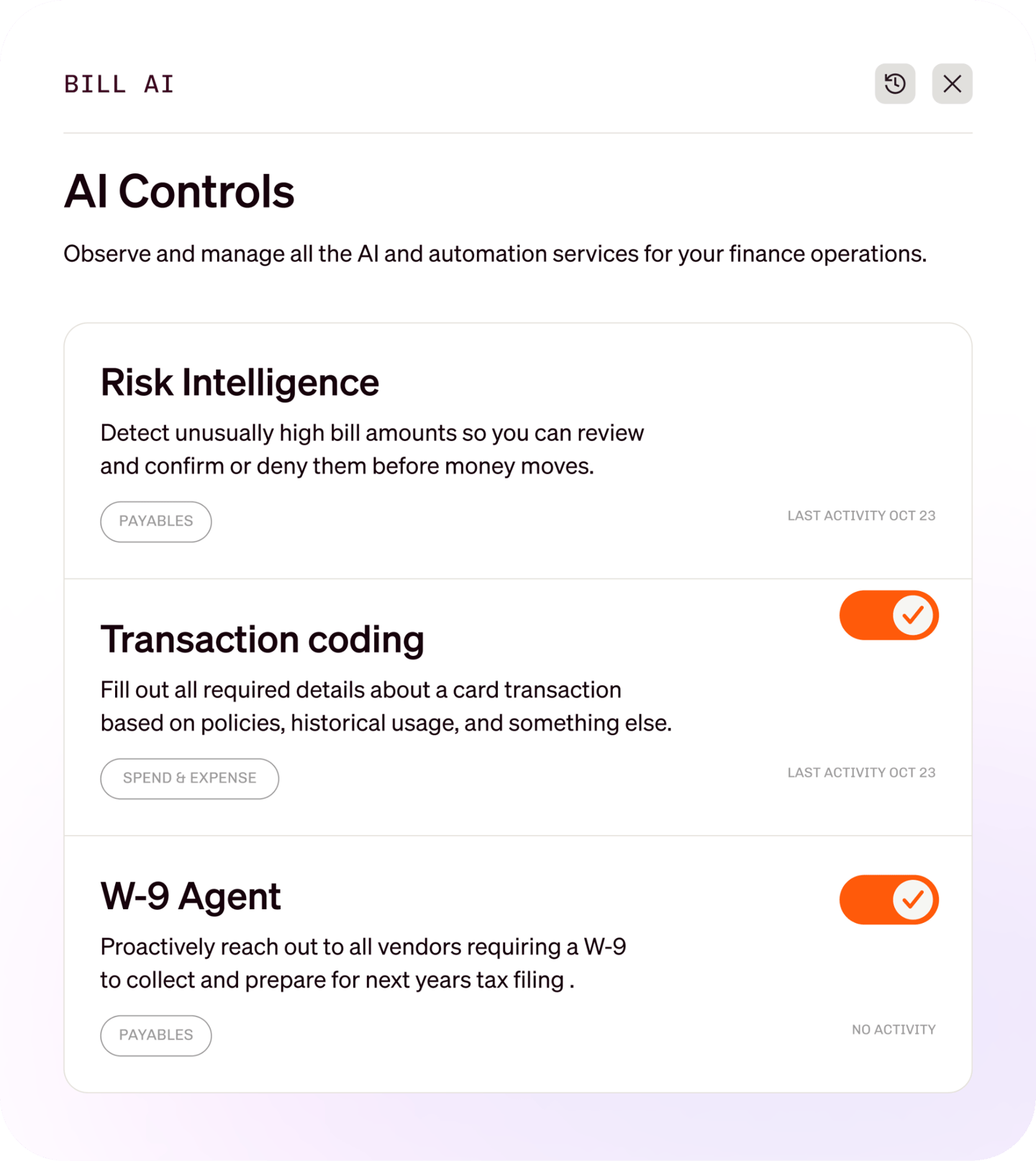
That last part matters more than it might seem. Tech-forward startups and enterprise companies want to manage every AI agent individually, tweaking each one. Most small businesses don’t want that level of granularity. They need the benefits of many agents, but they don't have the time or interest to manage each one. A single dial for how much autonomy to grant is exactly the right abstraction for them.
And visibility isn't just reassurance. It's the evidence that trust gets built on. Every logged action the owner reviews and agrees with is one more reason to turn that dial in the direction of more delegation.
5. Gate by risk, not by task
Here's an uncomfortable truth about "human in the loop." Anyone who has used an AI coding tool knows what happens after the twentieth approval request: You stop reading and start thoughtlessly clicking yes.
The better approach is to gate automation by risk rather than by task type. Instead of "AI handles capture, humans handle approvals," the harness asks a different question about every single item: How confident are we that this one doesn't need a person? A routine invoice from a long-standing vendor, matching its usual amount, sails through. The legal bill that's 33 times bigger than normal stops and waits for a human.
This is the mechanism that breaks the compounding problem. A risk check between steps catches an error before it can carry through the rest of the workflow. And it makes human attention scarce in the right way, so that when the owner is asked to look at something, it's because it genuinely deserves a look.
What makes this work is calibration, not perfection. The system doesn't have to be right about everything. It has to know when it's right.
Knowing What Normal Looks LikeCopy anchor linkCopied
There's one more ingredient, and it's the one that makes the risk gating in principle #5 possible.
Think about the difference between an AP clerk on their first day and one who has worked the same vendor list for ten years. The veteran isn't necessarily smarter. But they've seen enough invoices to know what normal looks like: Which vendor always bills a little high in December, and which jump means something is actually wrong. That knowledge is what lets them wave through the first and stop the second.
A risk score works the same way. It's only as good as its sense of normal, and normal is learned from history. Is this invoice unusual? That depends on what this business has paid before, what this vendor has billed before, and how invoices like this one typically behave. A harness with thin history will either flag everything, which trains owners to ignore it, or flag nothing, which is worse.
This is why, as I argued back in June, context is the product. The judgment of an AI agent is only as trustworthy as the context it has to work with.
It's also where breadth starts to matter. Anyone who has tried to set up a personal AI agent knows the pain of stitching together a dozen different connections just to give it a basic picture of your life. For a small business, the more of its financial life that already lives in one place, the less stitching is required, and the better the harness's sense of normal becomes. BILL, which says it serves nearly 500,000 businesses and processes roughly 1% of US GDP annually, flagged about $1.5 billion in customer payments in fiscal 2026 that turned out to be simple mistakes or unusual payments. That's the kind of pattern recognition that only comes from seeing a lot of payments.
The model provides the capability. The harness provides the trustworthiness. And the context is what gives the harness good judgment.
Handing Over the WorkCopy anchor linkCopied
Let's go back to that HVAC installation company with the one-box finance org chart.
The promise of AI for that business is enormous. Not a slightly better version of the tools it already has, but the treasury function, the procurement team, and the AP department it could never afford to hire. Zero to one.
But that promise only gets kept if the owner actually hands over the work. And the owner, quite reasonably, is not going to hand it to something they can't see or check.
What gets them there is the same thing that gets any of us to delegate. Trust gets extended gradually, starting with small, low-stakes jobs. It gets extended with a clear view of what's happening. It gets extended to someone who has shown, again and again, that they know what normal looks like and what to do when something isn't. And it grows as it's earned.
The models are going to keep getting smarter. That part of the story is mostly taking care of itself. The harder and more interesting work is happening in the harness: The scope, the tools, the ladder, the visibility, and the judgment about when a human needs to step in.
Which is why I suspect the winners in AI for small business finance won't be the companies that build the most sophisticated agents. They'll be the companies that build the agents small business owners are actually willing to trust with their companies.
ABOUT SPONSORED DEEP DIVES
Sponsored Deep Dives are essays sponsored by a very-carefully-curated list of companies (selected by me), in which I write about topics of mutual interest to me, the sponsoring company, and (most importantly) you, the audience. If you have any questions or feedback on these sponsored deep dives, please DM me on Twitter or LinkedIn.
Today’s Sponsored Deep Dive was brought to you by BILL.
BILL is the intelligent finance platform trusted by nearly half a million businesses and more than 9,500 accounting firms, with more than $2 trillion in cumulative payment volume. BILL's AI agents take on work like risk intelligence, invoice coding W-9 collection and more, inside the approvals and policies finance teams set, so they can see and manage what AI is doing before and after money moves. Learn more at bill.com/ai.
Thanks for the read! Let me know what you thought by replying back to this email.
— Alex