Small Business, Big Onboarding Problem
Sponsored by: Taktile

Editor’s Note — This article is sponsored by Taktile. As with all sponsored content in Fintech Takes, this article was written, edited, and published by me, Alex Johnson. I hope you enjoy it!
Business onboarding is broken.
Broken enough to cost banks business: a 2024 BAI survey found that 16% to 20% of small business owners started opening an account online but didn’t finish. Half of that group abandoned the attempt altogether (often because the bank couldn’t verify their identity without a trip to the branch). And that's just when it comes to opening an account.
Small business lending, its most document-heavy incarnation, shows us why business onboarding breaks down. Consider what happens when a small business owner applies for a loan.
It's a lot like filing your taxes.
Scratch that; it's worse.
At least with taxes, there's one set of rules, software like TurboTax, and accountants and CPAs for hire. With small business lending, every bank is its own country. And I don’t mean that facetiously; every bank requires something unique, and there's no standardized system to guide you. Imagine filing your taxes in 25 different countries. That's what it’s like shopping around for credit as a small business owner.
That’s pretty strange when you consider how well we’ve automated consumer lending. Know Your Business (KYB) sounds like the business equivalent of Know Your Customer (KYC), but process-wise, it’s closer to filing taxes than proving your identity.
Here’s the problem. Small businesses are incredibly diverse, and they always will be. That diversity creates friction for borrowers and institutions alike, and the sheer variety of businesses makes KYB enormously challenging to standardize.
So how can we make the inherent edge “case-yness” (if you will) of small business lending and KYB less burdensome to everyone involved?
Read on for my idea.
A Rock And A Hard PlaceCopy anchor linkCopied
For borrowers, even knowing which documents you need for an application can be maddening. Maybe you checked a box when incorporating three years ago without really understanding it. Now a lender wants extra documents. You submit your application, then hear back that something’s missing two weeks later.
An accountant can tell you whether your tax return is ready to file. Who does that for your loan?
In lending, institutions are trained to build standardized, straight-through processing that most applications can sail through. Except when one business is an S corporation, another an LLC, and a third lists a beneficial owner alongside four other people who aren't on the application. Then it’s time for manual review!
Unless you specialize exclusively in a particular product or customer segment (as we see with vertical SaaS companies like Toast and Mindbody), much of your volume can end up in exceptions.
Borrowers need to crack the code on requirements; lenders can't master every exception. Rather than hope small businesses become more alike, we need more efficient infrastructure for handling all these edge cases.
Infinite SpecializationCopy anchor linkCopied
Suppose one in every thousand applications has a particular, bizarre ownership arrangement. You’d never hire an underwriter whose entire job was to master that one eccentricity, but you could build an AI agent for it.
Agents are flexible units of intelligence that can help master specific steps in the onboarding process, and handle obscure cases. You can, in theory, infinitely specialize.
For borrowers, Taktile's Application Completeness Check Agent can flag missing material before an application sits in a queue, like an accountant saying, Yep, you've got everything. For lenders, its Business Ownership Intelligence Agent can trace corporate ownership chains, while its Financial Spreading Agent organizes financial statements for credit analysis.
Consider beneficial ownership. Before a financial institution can onboard a business, it has to identify who ultimately owns or controls it. That means following corporate ownership through successive holding companies and different corporate registries. In September 2026, Taktile Labs tested AI agents on precisely that task, using real UK and German registries. Four leading models correctly reconstructed all 55 expert-checked company ownership structures, including chains up to 12 levels deep.
That’s a lot of investigative legwork before anyone can even make a credit decision. We want humans making the final judgment; we don't need them chasing down documents to get there. Likewise, borrowers should review an application assembled for them, just as they’d review a tax return prepared by an accountant.
Small business onboarding may never fit the model of fully automated straight-through processing, with one model evaluating the business against consistent data. But with specialized agents handling the exceptions, we might not need to.
But Who Watches The Agents?Copy anchor linkCopied
The concern, whenever you bring in AI agents, is what happens when the agents do something weird or unexpected?
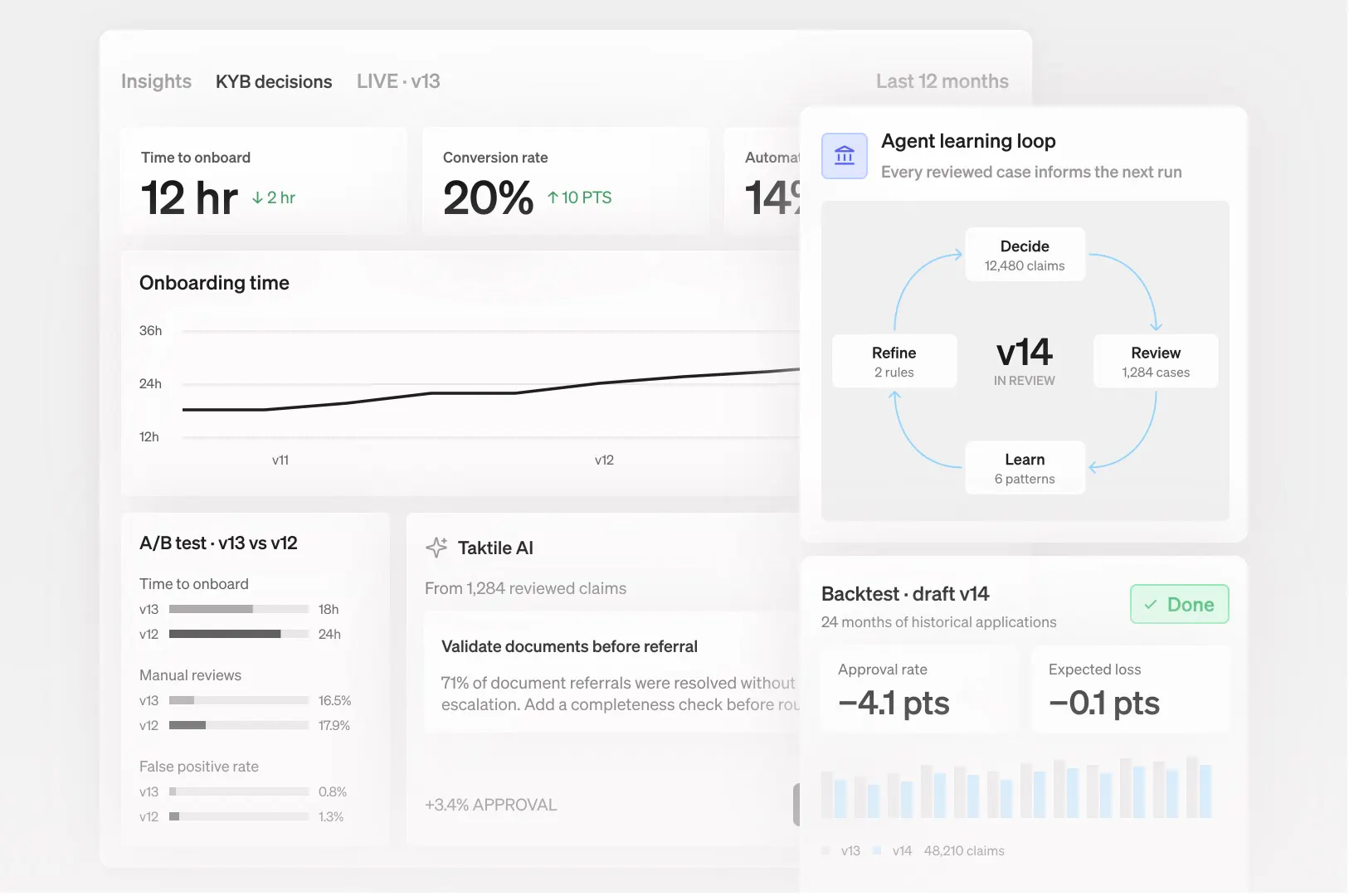
This is a reasonable concern, although I sometimes think we hold AI agents to the unfair standard of deterministic, rule-driven systems and machine learning models. Sure, they're less consistent than those systems, but I'd argue that they're probably more reliable (and auditable) than us, the humans. In traditional small business lending, inconsistency creeps in well before anyone reaches a lending decision, as different employees collect different information from the same file.
The solution that we use with humans — deterministic rules and guardrails wrapped around intuitive, probabilistic units of intelligence — can work with AI agents too.
Taktile’s research shows what such an approach can accomplish. In one example, 11 models investigated 87 corporate ownership cases, including records that were incomplete or contradictory. With general instructions, they got 75% – 90% of cases right; with country-specific guidance and deterministic rules, that became 95% – 100%. Consider two companies that registered as owning one another. An agent can collect both records, but a rule should flag the case for human investigation. Left to general instructions alone, the agent caught this contradiction only 35% of the time. Once the rule was added, that number hit 100%.
In other words, an agent can accurately reconstruct a deeply complex ownership structure and still fail to recognize that something in it requires a human touch. That's why the rules governing an agent's work are as important as the agent's ability to perform it.
And if we're going to spin up specialized agents to handle all the strange edge cases in business onboarding, we need a way to govern them collectively (without leaving onboarding teams accountable for decisions they can't see or steer). That's the case for a common substrate, a decision layer that contains specialized agents under enforceable rules and preserves human review. After all, regulators will always need institutions to show how their agents reached a conclusion, and when a human intervened.
We've built processes that struggle to accommodate the wild heterogeneity of the businesses they're meant to serve. Small businesses won’t ever become more alike, but for the first time, AI agents can offer a new path to specialize across that staggering diversity.
And with it, the possibility of radically changing the cost and friction of business onboarding for institutions and borrowers alike.